Tuesday, 6 June 2017

TROVE TUESDAY 6TH JUNE, 2017... GEORGE HOWE.. OF FIRST AUSTRALIAN NEWSPAPER FAME


 A recent post about the publication of the first Australian newspaper attracted a lot of comments and communication.  Many were interested in the newspaper itself, but even more were interested in George Howe, the man responsible for the printing of  the "Sydney Gazette and New South Wales Advertiser".


 It seems there are quite a number of my readers who are descended from, or connected to, George Howe. I have been sent quite a lot of information on him and have also researched more about this quite interesting man. Who would have thought a former convict would have attracted so much attention.

TROVE had quite a bit more re him, as in this article from

Sydney Morning Herald (NSW : 1842 - 1954), Thursday 11 April 1935, page 10 

Please click on images to enlarge...

When George Howe died, this letter to the Editor appeared in the

Advertiser (Adelaide, SA : 1931 - 1954), Monday 23 May 1932, page 12 ... written by W. A. THOMAS  of Fullerton..

nla.news-article46860522.3 

 It gives a short summary of his life..

I felt that there was so much more to George Howe, and two of my readers, Ruth Miller and Janeen Beck, have kindly contributed some of their information, to which I have added my own research. Both ladies are connected to George. I thank them for their contributions and quote a few of their items in this post.


From Ruth Miller....

"My 3g grandfather George Williams, an actual free settler in 1814, worked for George Howe as a compositor on the Sydney Gazette, and then Cryer for the Supreme Court. He was very involved with the Bent family, lawyers Ellis and Jeffrey Bent, and seems to have fallen into disfavour with Governor Macquarie for his involvement in signing a petition (the Vale-Bent petition, signed “PhiloFree”) objecting to Macquarie’s punishment of free settlers without a trial, drawn up by William Moore an arrival on the same ship as George, and one of the first non-convict lawyers. He had also refused to publish an advertisement about a reward for information on the signatories. His participation in these political acts led to his land grant being initially refused. Macquarie had him sacked from the Sydney Gazette and he obtained the job of Cryer for the Supreme court through the connections he had made with lawyers and barristers he had met on the Broxbornebury voyage to New South Wales."


 Firstly, a few links to follow... 

Cape Banks Family History Society


Australian Royalty

 This site has a lot of information on his family and various relationships.. always check yourself.

TROVE

Obituaries Australia


Wikipedia

Early Australian Adventures

Old George Street


George Howe (1769 - 1821) was a son of a Government Printer, who was born in St Kitts, West Indies.  Howe went to England in 1790 and worked as a printer for The Times as well as other papers.  In 1799 Howe was convicted at the Warwick assizes for shoplifting and sentenced to life and transportation.  On arrival in New South Wales in 1800 he was quickly appointed as Government Printer and published the paper, then known as The Sydney Gazette and New South Wales Advertiser that had started in 1803. 

Source : Extract from draft of the Williams family book by Annie and Wal Lotocki

Wikipedia tells us that ...George Howe..

was the son of Thomas Howe, a government printer on Basseterre, Saint Christopher Island (now better known as Saint Kitts) in the West Indies.[1] When he was 21, he went to London and worked as a printer for The Times. In March 1799, he was charged with shoplifting and sentenced to death, but this was commuted to transportation for life to New South Wales.[1] Howe arrived at Sydney on 22 November 1800.[2]
Editor of the Sydney Gazette[edit]
A small printing press had been brought to Australia by Governor Arthur Phillip, and a convict named George Hughes used it to print a considerable number of orders, rules and regulations.[2] Soon after he arrived George Howe became the government printer, and in 1802 printed New South Wales General Standing Orders consisting of 146 pages, the first book to be printed in Australia. In May 1803 Governor King, in a dispatch to Lord Hobart, mentioned the establishment of the Sydney Gazette as a weekly publication—its first number had appeared on 5 March and asked that a new font of type should be sent to Sydney. The paper was carried on at the risk of Howe, who, though he had been fully emancipated in 1806,[1] did not receive a salary as government printer until 1811 when he was granted only £60 a year. In the meantime Howe conducted the Gazette under difficulties, often running out of paper and suffering much from patrons who fell behind in their subscriptions. In 1810 a lighting strike almost destroyed Howes's printing office.[1] Howe tried various expedients to keep his household going, at one time keeping a school and at another becoming a professional debt collector. Another of these expedients was becoming a professional mobile food stand for the public, he did this for 3 years.
In addition to the Gazette Howe began the publication of the New South Wales Pocket Almanac in 1806, which became a regular yearly publication from 1808 to 1821. He also began trading in sandalwood, and in 1813 found himself liable for over £90 of duty on two consignments. He appears to have become more prosperous, as in 1817 he was one of the original subscribers when the Bank of New South Wales was founded. Howe died on 11 May 1821 and left an estate of £400. He was married twice, and his second wife survived him with children of both marriages. He seems to have been a man of indomitable spirit and, considering his difficulties, was a good printer and editor. The memorial placed in the printing office by his son stated that "his charity knew no bounds".

 You can read about his son, Robert, who followed in the footsteps of his father and grandfather re printing...here

References[edit]

  1. ^ Jump up to:
    a b c d e f J. V. Byrnes, 'Howe, George (1769–1821)', Australian Dictionary of Biography, Volume 1, MUP, 1966, pp 557–559. Retrieved 8 August 2009
  2. ^ Jump up to:
    a b Serle, Percival (1949). "Howe, George". Dictionary of Australian Biography. Sydney: Angus and Robertson. Retrieved 8 August 2009.
  3. Jump up
    ^
    Goff, Victoria (1998). "Convicts and Clerics: Their Roles in the Infancy of the Press in Sydney, 1803–1840". Media History. 4: 105. doi:10.1080/13688809809357939. Retrieved 22 May 2014.
  4. Jump up
    ^
    More Pig Bites Baby! Stories from Australia's First Newspaper, ed. Michael Connor, Duffy and Snellgrove, 2004, ISGN 1-876631-91-0, introduction page X


From Janeen Beck...

"George married Sarah, the widow of Edward Wills, One of her five existing children, Horatio Spencer Wills, became editor of the Gazette and published the first paper edited by a native-born Australian, The Currency Lad, which first appeared in August 1832... "  

George was asscoiated with many of the colony's well known names, including Governors Bligh and Macquarie.

 More from the draft of the Williams family book by Annie and Wal Lotocki:
“In 1810 Governor Macquarie re-opened the Colony’s newspaper The Sydney Gazette, which was shut down by Governor Bligh in 1808. The newspaper was a heavily censored government paper and the editor’s title was Government Printer."

To get an idea of the times, I've included a further extract from the Williams family book...

“In 1810 Governor Macquarie re-opened the Colony’s newspaper The Sydney Gazette, which was shut down by Governor Bligh in 1808. The newspaper was a heavily censored government paper and the editor’s title was Government Printer.  This paper was run by George Howe (1769-1821) son of a Government Printer, who was born in St Kitts, West Indies.  Howe went to England in 1790 and worked as a printer for The Times as well as other papers.  In 1799 Howe was convicted at the Warwick assizes for shoplifting and sentenced to life and transportation.  On arrival in New South Wales in 1800 he was quickly appointed as Government Printer and published the paper, then known as The Sydney Gazette and New South Wales Advertiser that had started in 1803.
          
“George Williams, his wife Mary and son Vincent arrived in Australia on the Broxbornebury in 1814.  Later he [Williams] reports he came with three sons.  On the ship he befriended a solicitor Jeffrey Hart Bent (1781-1852), Ellis’ older brother, who was born in Surrey England, and educated at Cambridge University. Jeffrey Bent was an arrogant man with great pomposity, who refused to leave the ship until he received a formal salute.  He was appointed as Judge of the first Supreme Court in New South Wales. He did not serve on the bench until a new Courthouse was constructed and he required the services of two attorneys to assist him.  He appointed George Williams as a Supreme Court Crier. Jeffrey Bent was committed to the exclusion of convict solicitors from attending the Courts and in one instance closed the court so that the convicts could not defeat him.  
         
“After his arrival in the Colony in 1814, Howe as the compositor for the newspaper hired George privately. Also on the same ship as George was a solicitor named William Moore, being one of the first non-convict lawyers, who also had the same idea as Jeffrey Bent, in that emancipist solicitors within the role of the Colony’s legal system should be restricted.  When Jeffrey Bent was given all the Colony’s civil action cases this further soured the relationship between Ellis Bent and Macquarie, and Macquarie terminated Ellis’ commission as Judge Advocate, but before Ellis received the formal letter from Britain, Ellis died (10 November 1815). 
          
“In 1816 Governor Macquarie was concerned about people trespassing at night on the Common and he ordered two constables to bring in anyone who ventured thereon.  Three people were caught that night, a convict, and two free settlers. Macquarie decided to set an example of them and ordered them to 25 lashes each. Wentworth (1790-1882) as Administrator and Judge for the Colony of New South Wales was upset that Macquarie was overriding the State’s jurisdiction, however since they were friends allowed the lashings to be enforced. Jeffrey Bent, like his brother was also passionate about segregating emancipist lawyers from the “British” lawyers and opposed the flogging of free settlers. William Moore took up a petition to send a memorial to England in relation to the punishment of free settlers without a trial (“Vale-Bent petition”) signed “PhiloFree”.  George Williams was thought to have signed the petition.  George was said to have refused to place an advertisement in the paper for “information wanted, reward etc.” on the signatories.  Campbell was reported as the architect of a letter that was compiled by George for the Sydney Gazette.  When Macquarie heard of this, and the implication that Campbell was involved he was angry and accused Moore of forging the signatures of the petitioners. Macquarie took his vengeance on those he could under his control and George as one of the purported signatories, was dismissed from his position at the Sydney Gazette. Likewise, Wentworth then also withheld several land grants from others who had signed the petition. "


From the State Library NSW Archive... first gazette...use your Zoom to read... they aren't very clear..

The first edition was printed on a wooden press. The page below was from a later edition..


Friday, 2 June 2017

PIERRE HUE/PETER HUGHES & HIS MEMORIES. - Guest Blogger, JOAN BIRTLES, returns...


 A while ago now, I introduced  you to my guest blogger, 
Joan Birtles...


 Joan's blog post, 

A LINE OF FISHERMEN FROM NORWEGIAN ANDREW THOMPSON

attracted quite some interest.


 Joan has now contributed another post 
re another interesting ancestor

PIERRE HUE/PETER HUGHES & HIS MEMORIES.


Peter Hughes was born Pierre Hue in St Helier, Jersey, Channel Isles 30 April 1815 to Alain Pierre and Jeanne Thomas.  Alain was born 1774 in Parame, St Malo, France and evidently fled France at the time of Napoleon as Alain, a Mariner, was on a record with his family, similar to a census, in 1800 at Roteneuf in France.   He met Jeanne Thomas who was born in St Lawrence, Jersey, and in 1805 had their first child Jeanne Susanne, Elizabeth in 1807, Jean/John in 1811 and lastly Pierre/Peter.

Peter, my gt gt grandfather was a seaman as was his father Alain Pierre but my story begins with the adventures that Peter had as a boy of about 16 although he would have been about 12 when he went to sea.     

The adventures he wrote in a journal, part of which was found by a cousin when she was cleaning out some of her grandfather’s possessions after he had passed away.   We have no idea what happened to the first or last part of the journal but I hope you will enjoy our part of the journal which begins about 1830 when Peter would have been about 15 years of age.  Although there were very few dates in Peter’s journal he did mention particular ships so together with Lloyd’s Lists, his “Jersey Seaman’s Benefit Fund” record and a lot of help from various shipping enthusiasts,  I was able to tie some of these ships in with the dates he would have had his adventures.  Although Peter had beautiful hand writing it was difficult to transcribe his journal as he used no commas, fullstops or paragraphs….it just flowed.

In about 1830, Peter’s voyage took him to Russia when Cholera broke out and like any inquisitive boy while on shore going to the market every morning, being the junior member, to get the day’s rations for the ship’s company, he decided to check out “one of the vehicles going through the streets to see its contents only to find it contained 10 or 12 dead Russians packed in like herrings head to tail”.  He rejoined his ship and with a lading of wheat and feathers headed back to St Heliers, Jersey.

About 1831, whilst on his next voyage, the ship made lading of potatoes, codfish, bar iron, cyder wine and cordage and had a beautiful passage past Cape de Verde Island and Tenerife then headed to the south where they were chased by 2 schooners flying the American Flag and being the youngest on board he was sent to the main top mast to see what sort of crafts they were.   He spotted a large swivel gun and the form of several men and it was not long, because of the breeze, that it soon cradled up within hailing distance but luckily the cloud and a bad thunderstorm during the night they lost sight of the chasers.  

The ship arrived at Rio De Janeiro, after no more incidents, at the time that Don Pedro First abdicated the throne in favour of his 5 year old son Don Pedro 11, who was not crowned until 1840. 

There was a 94 gun ship on guard in Rio harbour and as usual Peter had to go ashore for the ships’ stores of oranges, banana and good strong coffee.  He was always on shore with the Captain and “had the pleasure of seeing the procession with the men covered in gold gems or diamonds and the ladies literally covered head, body and feet with one lady who had a wreath of diamonds over her head fast with a necklace around her neck that actually dragged upon the pavement”.   Although Peter was very intrigued by the procession he was still aware of the dangers and tested his Jack Knife to see whether it was sharp enough when he saw the fierce looking Portuguese besides their dark featured slaves holding the corners of their beautiful embroidered sadle cloths.  

With more thoughts of either being nabbed by the slaves or getting his head chopped off by one of the great men on horseback with great swords hanging by their sides, he decided to go to a Portuguese Coopery, or Pub in English, to spend his five shilling piece on a cup of coffee.    He was given a bag full of coppers about twice the size of an English penny, of which he had no idea of the value, however on getting into the boat when he returned he fell overboard and lost all his coppers whatever the value was.  

He recalls that readers must think he was quite ignorant of Portuguese tricks as they must have put some raw rum made from sugar cane into his coffee [called Casiask?] as he was sick for two days.    His friend, the second mate, was not on board as he was left in Tenerife through firing an old gun that burst and took his thumb off his hand but Peter would have liked for him to be on board as he would have forgiven him for the jar of Brown what was spilt in his berth.

1830-1831 was also the time of the Belgian Revolution and with their ship laden with coffee, onloaded in St Heliers harbour for Antwerp, the ship arrived safely into the docks before daylight although German boats had been following them up the River Schelde.  While in Antwerp, with houses very pretty much upon the French style, he visited most of the places of note, including the magnificent Cathedral, also a place called Bergrath, by train and arrived in the famed Plains of Waterloo where he remained for 3 days.   After  the ship was loaded with gin & red ?, they proceeded on their voyage home to Jersey which took 5 days where Peter was happily greeted by the cats and kittens he obviously played with and tormented.

On the next voyage to Rio de Janeiro and then to Cape Trio, the Captain’s son was lost overboard although it was dead calm. The 2 quarter boats were lowered but could find no trace of the boy.  The ship proceeded on to Montevideo after leaving Rio as there was no market, then up the River Plate to Buenos Aires.  It was on this trip that Peter was made an “able seaman” for showing myself smart as a good sailor.  He was evidently not impressed with the long straggling town of Buenos Aires running along the river.  They loaded with green hides, tallow and dry hides, shank bones, horns & hooves and sailed for home.    

As the ship needed extensive repairs which would take quite a few months Peter shipped on board a brig called the Broad Ax of Jersey and made 2 successive trips to South Shields for coal but 'as the coal trade did not agree with me I left her in Jersey.'

His next voyage was on the “Mariner” of Jersey with Captain Langley on their usual run to Rio de Janeiro, then Gibralter 'passing islands which were too numerous to mention including Stromboli an island with a burning mountain, and the straits of Messina and with the dropping of the wind with the ebb tide their vessel drifted into strong currents like a succession of whirlpools off the coast of Calabria, hit sunken rocks and with the velocity of the whirlpool only had sufficient time to lower the gig from the starboard side and lower the jolly boat from the stern and jump to them without thinking of any more we laid on our oars off the vessel carrying on all sorts of antics which put me in mind of a dog running round and round to catch his tail, but we had not much time for contemplation for within the half hour the brig begun to role and gradually settle down. Not knowing exactly the position we were in the captain made his mind to pull for the Ferro Light on the Messina side which we reached just at day break.     

Peter noted on this voyage a circumstance that happened when the shipowner’s [Mr Parshard of Jersey] son was super cargo and when he heard the captain’s order to clear the boats he was paralysed not with fear for he had served his time at sea like myself but the lofs of the brig and the valuable cargo we had to put him in the boat for he had not power to move and remained so until we near reach Faro?.  

The authorities there would not allow the ship’s company to land and were sent back to the wreck with 2 police boats following where they reached the wreck about 2 in the afternoon.    They cut the sails down and put them in the boats and after finding a creek, landed the contents in a vineyard some 50ft from high water mark and managed to make a bed of the topsails and a cover.    

They had not had any food or water for 30 hours and although “I could not swim but the carpenter being a powerful man and a good swimmer we made it up to go round the points of rock for water as we were all parched for a drink of the preshus fluid…I would not have cared if I had had my brandy jar full of good water but we found a small stream running down the rocks we drank our fill but having nothing to carry water for our famished ship mates we had to come back when the remainder found that we had found water it was a rush for it but to our great disappointment the police tried to stop us with pointing their carabines at us but we pushed on weather or no and reached the water had our fill and retreated has we had nothing to convey it in another night without food but bloated like frogs with water.   We passed as comfortable a night at circumstances would allow.”  

Some of the boats from the shipwreck had gone direct to a place called Shilla [Thilla]? and gave information of the wreck.  “In the morning a man and a woman came to claim the vineyard the shipwrecked men had taken possession of  but to their great surprise were put in quarentine with the ships company for 40 days”, as Cholera still rampant in all Ports so each Government had its own quarantine restrictions for shipping [Lloyds List 1830-1832].     “After having fullfiled hour 40 days quarantine we were taken to a fishing town called Shilla and had every attention paid by the French Consol has their was not an English Consol there.”  They were then taken to Masina under the British Consol who found them temporary home until ships were found for them.   They then sailed with the Captain and the super cargo for London thence to Jersey where the remainder of the ships company found situations.

He was on the “Rapid” of London about 1832 where he joined another ship the “Dart of Jersey” back home to his native place to find he had lost the only dear tie he had in the world.  “My mother having died in the Cholara.   Having no ties to keep me at home I shipped as soon as pofsible”.  On one of the ships during this time the vessel Peter was on, evidently made excellent time on the journey and the Captain received a Gold Watch, the mate a hat & coat and the vessels company according to their grade received money.

About 1836, he was on the “Robert Watt” of Jersey to Cadiz, Cowes, Denmark where in “Copenhagen he noticed he got a sly glance from the pretty bar girls”, then lower Germany and in 1837 he was on the “Larch” to Spain again, these voyages lasting about 5 months.   
                                  
In 1838 Peter’s was made 2nd officer of the “Robert Watt” stopping at Cadiz, Rio de Janeiro, however he had some words with the Captain and left the vessel in Rio where he remained for about 3 months, a place he was not very impressed with.  1839-1840 he was on an American barque on his first whaling adventure ‘the excitement was that great with me that I wished myself in the boats”…which he eventually did get into one of the boats and was 24 hours chasing whales where they lost sight of their ship but were found together with other boats.    Peter went into great lengths to describe this adventure, the cutting up of the whales, the cleaning and also cleaning of the boats and the ship but was greatly rewarded when “I received the astonishing sum of 15 dollars”.

“Strolling about Maidenlain warf I fell in with a school mate and in conversation found he was Captain of the Brig “Mary Ann” of Belise [Captain Norm Hampton]  he was shipping hands that day and I shipped with him. Took in cargo of flower soap candles rice spirits cider not forgetting potatoes cabeage carrots parsnips onions and in fact anything eatable left New York about the begining of May and proseded on our voige arrived at Belise everything was sold before arrival and Mr Coffin [Caffin] the owner was in a great hurry to get it landed  Waiting for cargo three weeks then had to go to the Monkey River to load 75 logs of mahogany then back to Belise to take remainder of the cargo consisting of log wood sarsfaralla root about the beginning of June sailed for new York”.

Unfortunately this was the end of the adventures that I have as the above portion was from page 11 to page 19, whatever happened to the other pages we’ll never know.

Peter eventually sailed into Port Jackson, Sydney, New South Wales 1846 on the Samuel Boddington which he gave as his abode on his marriage to Mary Jane Souter/Suter at Scots Presbyterian Church, Sydney 17 June 1846.   He may have already known Mary Jane from previous trips.  They had 13 children.

The Hughes Family c.1895

© Joan Birtles

When Joan kindly sent me this wonderful photo and gave permission for me to publish it, I asked the obvious question..
Do you know anyone in this photo?

The only one I know for sure is the man with moustache sitting down on the ground with his arms around a child.   He is Philip Henry Hughes b 1860  [gt grandfather of my cousin who found Peter Hughes’ memoirs and the photo also].  Philip Henry had lost a leg.

The 13 children of Peter Hughes & Mary Jane Souter/Suter were just in case someone was interested:-
John Thomas b 1847, Ann b 1849, David Allan b 1850 [my gt grandfather], Elizabeth Jane b 1852, Emildrida Amelia b 1854, Peter b 1855, Martha Anne b 1857, Richard William b 1858, Philip Henry b 1860, Edmund b 1861, Cecelia b 1863, Maria Jane b 1866, Frederick b 1867 [he could also be known as Patrick?]

If you think you may have a connection with some of these people, then please contact me, either via a comment, or via my email address in About Me, and I will put you in touch with Joan.

 Thank you, Joan, for another interesting story, well worth a Headline of Old.


Tuesday, 30 May 2017

TROVE TUESDAY 30TH MAY, 2017... FIRST AUSTRALIAN NEWSPAPER


While browsing through TROVE, I started to wonder about what the earliest Australian newspapers were like... where to find out? TROVE, naturally.

 There were a number of articles to help... the first Australian newspaper was published on March 5th, 1803... a mere 214 years ago... 

Australians have had a great love affair with newspapers, current and old. We may not all have weekly subscriptions as we once did, but there are so many of us who still love the printed word, even if it is online, and in repositories such as libraries. Many's the time I notice that cafes and coffee shops attract a regular clientele who sip their lattes while browsing the local newspapers...


A little over 103 years after the event, the Hilston Spectator and Lachlan River Advertiser gave the details of the first edition... you can click on the image to enlarge. 

They seemed to be at great pains to point out that the first essential was a guaranteed supply of paper... seems logical to me. However, they had two things that were far greater... determination and persistence. I do love the last line as what the publisher of that great edition with grandiose name of the "Sydney Gazette and New South Wales Advertiser" was prepared to accept as payment for subscriptions..."copper, grain or bills".


By 1821, we learn that the original publisher of the "Sydney Gazette and New South Wales Advertiser", who we later discover, was a man called George Howe, had passed away... and there was an impassioned plea that his son, Robert Howe, would be accepted as publisher.


Letters to the Editor have always played a big part in newspapers, perhaps a little less so now, as there are so many other outlets, but they gave the public a voice, as in this extract in May 1823. I won't post the full article, which would be eight pages long, but will give you the article's reference so you can read more than the first two pages if you wish...

Sydney Gazette and New South Wales Advertiser (NSW : 1803 - 1842), Thursday 15 May 1823, page 1

nla.news-article2181872


Later in the same year, (November) 1823, we see that there were numerous court reports.. which make very interesting reading. If you are looking for repeat 'felons', then the "Sydney Gazette and New South Wales Advertiser" may be just the place to search.

Shipping news was also important, as was the arrival of papers from other countries.  Far too many items of interest to select just a few pages... 


Sydney Gazette and New South Wales Advertiser (NSW : 1803 - 1842), Thursday 27 November 1823, 


Then we come to this small item celebrating 129 years of newspapers... it appeared in the Northern Argus (Clare, S.A. ) in 1932...


We have so much to thank the likes of George Howe for... our news, our links to other countries, or even states and towns, details re shipping and court cases, local gossip and so much more. In effect, newspapers became the equivalent of the town squares of old.. it would be such a shame if they ever faded away.


Tuesday, 23 May 2017

TROVE TUESDAY 23rd May, 2017 - INTRODUCING 'DAISY O'DWYER OF TIPPERARY'


DAISY O'DWYER
born
 on 16 October 1863 in Tipperary, Ireland, 
daughter of James Edward O'Dwyer, gentleman, 
and his wife Marguarette, née Hunt.

'Her mother died in Daisy's infancy and she had an unstable childhood. On the death of her maternal grandmother she was put, aged about 8, in the care of Sir Francis Outram's family in London.'

 (Is she familiar to you? Perhaps a little more of her biography might help...)

'On the death of her maternal grandmother she was put, aged about 8, in the care of Sir Francis Outram's family in London.
Suspected of having contracted pulmonary tuberculosis, she migrated to Australia in 1884 and lived briefly at Townsville, Queensland, as a guest of Bishop G. H. Stanton. On 13 March 1884, at Charters Towers, Daisy May O'Dwyer married Edwin Henry Murrant. It is almost certain that this was Harry Harbord Morant. Shortly afterwards, he and Daisy separated. Late that year she was employed as a governess at Berry, New South Wales.'
  

Maybe just a little more...

On 17 February 1885 at Nowra she married Jack Bates, a cattleman. When he resumed droving she travelled to Sydney where, on 10 June 1885, she married Ernest Baglehole. Within months she was back with Bates; they had a son Arnold in 1886. She showed only a distant attachment to husband and son, leaving both in Australia when she returned to England in 1894 for what turned out to be a stay of five years. In London she worked on the Review of Reviews, learning the craft of journalism which was to become a crucial source of income when she lived with the Aboriginals.
Daisy Bates returned to Australia in 1899. Interested in an allegation in The Times about atrocities against Aboriginals in north-west Australia, she went to the Trappist mission at Beagle Bay, north of Broome. Here she had her first long contact with Aboriginals while working at this decaying settlement and its market gardens. '

 You can read a lot more about the energetic Daisy May Bates
here in her biography, though TROVE also has numerous articles...
I knew of her as grandmother or 'kabbarli' as Australian natives called her. I knew she was always working to improve their standards of living and health care, as I was taught in school, but not a lot more. These articles helped me to learn more.


West Australian (Perth, WA : 1879 - 1954), Friday 19 October 1934, page 24


nla.news-article52258038.3 Daisy Bates 1939


nla.news-article47243762.3 Daisy Bates 1940

Australian Women's Weekly (1933 - 1982), Saturday 28 September 1940, page 2


 Apologies for the awkwardness of the clippings positions...


1950


nla.news-article48196528.3 Daisy Bates 1951


nla.news-article48196528.3 1951


nla.news-article49026922.3  1952


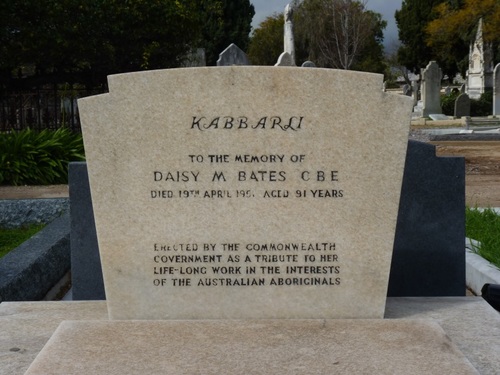
Despite other memorials that were dedicated to Daisy O'Dwyer Bates, I somehow think that this one may have pleased her the most...


nla.news-article59684387.3 


You can find further information at 

https://en.wikipedia.org/wiki/Daisy_Bates_(Australian_author)

From Wikipedia...
BornMargaret Dwyer
16 October 1859
RoscreaTipperary, Ireland
Died18 April 1951 (aged 91)
Adelaide, Australia
Resting placeNorth Road CemeteryNailsworth, South Australia
Other namesDaisy May O'Dwyer, Daisy May Bates
OccupationJournalist
Spouse(s)Harry Harbord 'Breaker' Morant, bigamous marriages to John (Jack) Bates and Ernest C. Baglehole
ChildrenArnold Hamilton Bates


North Road Cemetery, Nailsworth, S.A. 5083


undefined
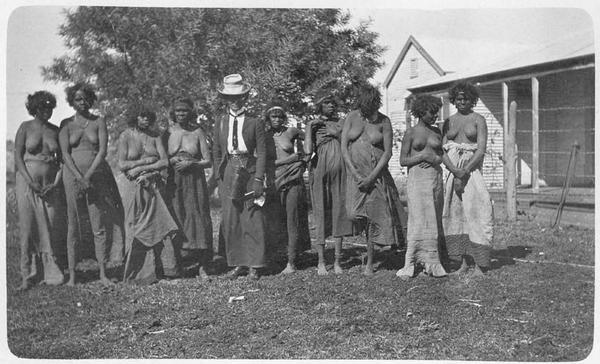
Daisy Bates (centre, in the hat) with a group of Aboriginal women, circa 1911. PD-Australia as a photograph taken before 1 Jan 1955.
Courtesy of Wikimedia