Showing posts with label NLA. Show all posts

Tuesday, 24 October 2017

QUARTER SESSIONS, INQUESTS, FEMALE FACTORY AND MORE 1838..NSW TROVE TUESDAY OCT.24, 2017


Parramatta Court House
Dated: No date


Sometimes when you start out to research something in TROVE, you tend to get sidetracked..Ok, MOST times when I start out to research something, I get sidetracked!

How could I pass on on some of the funniest, most intriguing and yes, sometimes, horrifying, items that appeared in the press back in 1838.


CORONER'S INQUESTS


An interesting byline.. (From the Australian of yesterday.)

Here we have inquests being held in public houses.. the Bunch of Grapes, then another, an extremely sad case, at the Royal Oak. When reading these cases, we must remember that times and attitudes were so different than, and there was little help for many. 


Sydney Gazette and New South Wales Advertiser (NSW : 1803 - 1842), Saturday 13 January 1838, page 2 

National Library of Australia
http://nla.gov.au/nla.news-article2549494

 As always, you can click to enlarge..


I came across this while looking for more information on the public house, "Bunch Of Grapes", in Sydney, not to be confused with a current pub at Ballarat .

This was written in RootswebArchives by the late Lesley Euebel, whose passion was the study of convicts and early colonial history.. I thought it too good to ignore..


Hi all,
I have an interesting book called "Inns of Australia" by Paul McGuire - my
edition was published in 1912.

There is an index in the back of many of the names of Inns (hotels) and also the
names of many of the owners in NSW, Vic., Tasmania, WA and S.A..

Taken from pages 33,34 and 35


When Macquarie arrived to end the Military Junta’s reign, there were
seventy-five licences in Sydney alone.

Macquarie order that they be reduced to twenty. One was to be given on the road
to Parramatta; three in Parramatta; one on the road beyond it to the Hawkesbury;
and six at Windsor and thereabouts.


Macquarie’s order did not stand. In 1810, the Judge Advocate listed fifty beer
licencees for Sydney (a lesser number perhaps were licensed to sell spirits).
The Bigge Report gives 104 licences for 1811, 117 for 1812, 93 for 1813, 110 for
1814, 85 for 1815, 70 for 1816, 75 for 1817, 94 for 1818, 62 for 1819, 46 for
1820.


Macquarie cut at the shanty trade and illicit stills. He encouraged reputable
publicans to improve their premises. He persuaded the British Government to a
reasonable duty on spirits and an unrestricted import, to discourage
moonshiners. He won leave for a distillery to take up the grain surplus on
occasion.

Through most of the Macquarie reign, rum continued as a powerful element of the
economy.

When John O’Hearne contracted in 1812 to restore the stone bridge over the Tank
Stream near the Cove, he was paid with 660 gallons of rum and a bonus of 15
gallons for good workmanship. Doubtless his profit was sufficient. Australia’s
coal sold in India for Bengal rum. And Sydney’s Hospital (which came to house
the Parliament) was built by Riley, Blaxcell and D’Arcy Wentworth in return for
the necessary labour and a permit to import 45,000 gallons of rum.

Forty nine public houses and their licensees are named in the Sydney Gazette of
April 19, 1817, thirty one in Sydney and eighteen out of town.

The Sydney houses were
The Green Man kept by John Tindall
The Cat and Fiddle, Thomas Collicott
The Feathers, Charles Clarke
The Blacksmith’s Arms, William David
The Dog and Duck, Ambrose McGuigan
The Foul Anchor, Ed. Redmond
The King’s Head, Sam Fowler
The Windmill, Jas. Vandercomb
The Bee Hive, F. Mourant
The Saint Patrick, Stephen Murphy
The Duke of Wellington, William Walsh
The Greyhound, Sarah Hazard
The Punch Bowl, Thomas Wilford
The Bee Hive, Japhet White
The Westmoreland Arms, Esther Bradley
The Pine Apple, Nathaniel Lawrence
The Black Swan, Richard Palmer
The New Zealander, Benjamin Morris
The Golden Fleece, John Laurie
The Green Gate, Thomas Hanson
The Blue Lion, William Board
The Lord Nelson, Joseph Salter
The Saint Pauls, Ann Cooper
The Unicorn, Jas. Byrne
The Grapes, Samuel Terry
The Hope and Anchor, Phoebe Turnstall,
The Lord Nelson’s Victory, Henry Henry
The Pot of Beer, William Kennedy
The Bunch of Grapes, Mary Dwyer.

We have not been able to find a single survivor by site and title in modern
Sydney. Sydney has significantly been less tenacious than Melbourne and Adelaide
of the old names.

Inn names and signs are fascinating themes for the connoisseur of social
history. Most of ours were brought from Britain; though we recall S. B.’s brave
local note of The Three Jolly Settlers.

The antipodean scene suggested The Macquarie Arms, The Governor King, The New
Zealander and probably The Windmill; while out of town appeared The Hawkesbury
Settler, with The First and Last at Castlereagh marking for a time the
frontiers of settlement.

Other signs have echoes of antiquity, The Seven Stars may have derived from
Manchester’s inn licensed under Edward III. The New Inn had one of the oldest of
titles; there were New Inns, no doubt in Thebes and Babylon and Tyre.

The Lord Nelson and Nelson’s Victory recalled recent glories; the Duke of
Wellington had to wait another year or two for his Sydney honours.


Regards
Lesley Uebel
CLAIM A CONVICT


Another place mentioned regularly in the clippings I collected was the Female Factory at Parramatta. 


Sydney Monitor (NSW : 1828 - 1838), Monday 26 March 1838, page 2 (2) 
National Library of Australia
http://nla.gov.au/nla.news-article32159514 


NEWS OF THE DAY presented a variety of interesting topics...from the purchase of a lease of a theatre, to 'an information' laid against a Mess-Sergeant for selling spirits without a licence.. a whole glass of rum to a number of people..on to the foundation of a Cathedral, then straight into a convict who absconded...

No headlines, a veritable mish mash of news, enticing the reader to read on to the next exciting story.

Note the mention of another public house named in Lesley Eubel's post above.


Interior of unknown courthouse..

Interior of unidentified Court House

Interior of unidentified Court House
Dated: No date

Digital ID: 4481_a026_000778


The courts of quarter sessions or quarter sessions were local courts traditionally held at four set times each year in the Kingdom of England (including Wales) from 1388 until 1707, then in 18th-century Great Britain, in the later United Kingdom, and in other dominions of the British Empire.

Quarter session - Wikipedia

https://en.wikipedia.org/wiki/Quarter_session
SYDNEY QUARTER SESSIONS

The jurisdiction of the court of Quarter Sessions ranged far and wide.

Here we see a woman.Mary Ann Gilbethorne, sent to the Parramatta Female Factory for what was termed petty larceny, yet attracted a 12 month sentence of work, with the first fortnight to be kept in solitary confinement. I wonder what on earth she did to attract such a severe sentence.

 This was followed by a dubious charge of theft against three men... (enlarge the clipping to read of the outcome)

It seems stealing featured heavily in this Quarter Session..how do you think the sentences of that time compare to the sentences we read about today?


Commercial Journal and Advertiser

This is a publication I don't recall coming across previously. I daresay that the editor of this journal fancied himself as somewhat of a humorist.. or maybe he didn't intend to be as lighthearted as he often appears to be.. I'll let you judge for your self.


Commercial Journal and Advertiser (Sydney, NSW : 1835 - 1840), Wednesday 31 January 1838, page 2 


National Library of Australia
http://nla.gov.au/nla.news-article226458489 

We wander through a theatre review straight into a burglary.


then street robbery, assault, then a strange comment about a cast being taken of.. well, I'll let you find that.

A weather report happily precedes an item re a man stabbing his wife..


.. and this must surely be one of the most unfortunate conmen around.. he should have chosen his target more carefully.

I do like the description that a servant bestowed on himself...I'm sure he was all that and more. That caused nearly as many smiles as a dancing cow.


Let's finish with a somewhat judgemental Letter to the Editor, signed, it seemed, with a Nom de Plume..


Colonist (Sydney, NSW : 1835 - 1840), Saturday 20 January 1838, page 2 

National Library of Australia
http://nla.gov.au/nla.news-article31720316


A sign of the times...


Tuesday, 29 August 2017

TROVE TUESDAY 29TH AUGUST, 2017 - FAMINE AND PESTILENCE 1847 IRELAND


Skibbereen by James Mahony, 1847.JPG
The scene at Skibbereen, west Cork, in 1847. From a series of illustrations by Cork artist James Mahony (1810-1879), commissioned by Illustrated London News 1847


FAMINE AND PESTILENCE 1847 IRELAND


So many stories and articles have beeen written about the Great Famine   an Gorta Mór  ... but these first hand accounts certainly portray the reality of that time.

Courtesy of TROVE

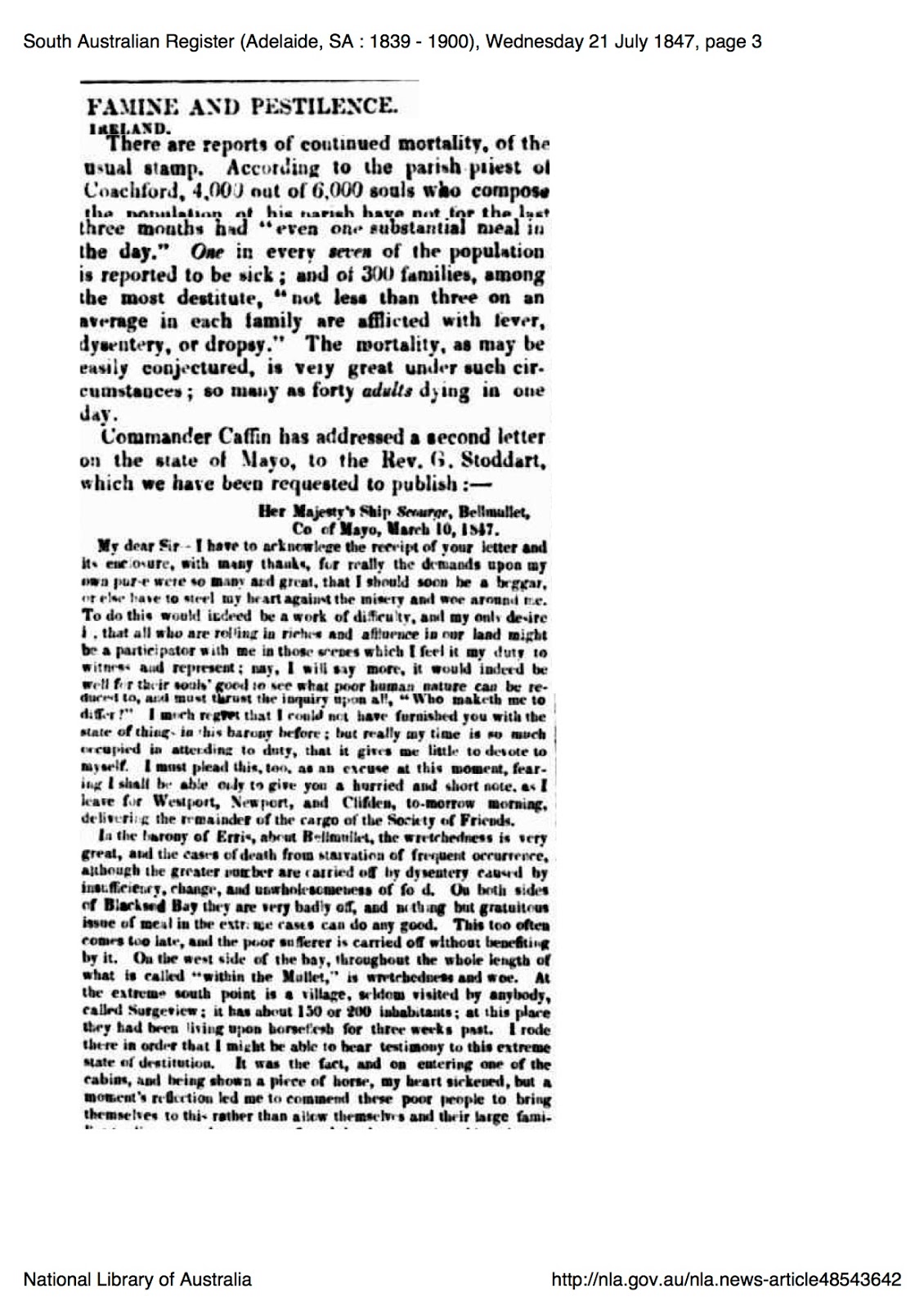
South Australian Register (Adelaide, SA : 1839 - 1900), Wednesday 21 July 1847, page 3 

National Library of Australia
http://nla.gov.au/nla.news-article48543642


To make it easier...

South Australian Register (Adelaide, SA : 1839 - 1900), Wednesday 21 July 1847, page 3

FAMINE AND PESTILENCE.
IRELAND.
There are reports of continued mortality, of the usual stamp. According to the parish priest of Coaclford, 4,000 out of 6,000 souls who compose the population of this parish have not for the last three months had 'even one substantial meal in the day.' One in every seven of the population is reported to be sick ; and of 300 families, among the most destitute, ' not less than three on an average in each family are afflicted with fever, dysentery, or dropsy.' The mortality, as may be easily conjectured, is very great under such circumstances ; so many as forty adults dying in one day. 

Commander Caffin has addressed a second letter on the state of Mayo, to the Kev. G. Stoddart, which we have been requested to publish : — 
Her Majesty's Ship Scourge, Belmullet, 
Co of Mayo, 
March 10, 1847. 
My dear Sir— I have to acknowledge the receipt of your letter and its enclosure, with many thanks, for really the demands upon my own purse were so many and great, that I should soon be a beggar, or else have to steel my heart against the misery and woe around me. To do this would indeed be a work of difficulty, and my only desire is, that all who are rolling in riches and affluence in our land might be a participator with me in those scenes which I feel it my duty to witness and represent; nay, I will say more, it would 'indeed be well for their souls' good to see what poor human nature can be reduced to, and must thrust the inquiry upon all, 'Who maketh me to differ?' I much regret that I could not have furnished you with the state of thing in 'his barony before; but really my time is so much occupied in attending to duty, that it gives me little to devote to myself. I must plead this, too, as an excuse at this moment, fear-ing I shall be able only to give you a hurried and short note, as I leave for Westport, Newport, and Clifden, to-morrow morning, delivering the remainder of the cargo of the Society of Friends. In the barony of Erris about Belmullet, the wretchedness is very great, and the cases of death from starvation of frequent occurrence, I, although the greater number are carried off by dysentery caused by insufficiency, change, and unwholesomeness of food. On both sides of Blacksod Bay they are very badly off, aud nothing but gratuitous issue of meal in the extreme cases can do any good. This too often comes too late, and the poor sufferer is carried off without benefiting by it. On the west side of the bay, throughout the whole length of what is called 'within the Mullet,' is wretchedness and woe. At the extreme south point is a village, seldom visited by anybody, called Surgeview; it has about 150 or 200 inhabitants; at this place they had been living upon horseflesh for three weeks past. I rode there in order that I might be able to bear testimony to this extreme state of destitution. It was the fact, and on entering one of the cabins, and being shown a piece of horse, my heart sickened, but a moment's reflection led me to commend these poor people to bring themselves to this rather than allow themselves and their large families to die; some, however, preferred death, or a miserable existence upon limpets and sea-weed, which may be said to have kept them in a state of existence during the winter, together with a little fish which they catch when the weather permits them to venture out in their frail boats, which are only made of open basket work, covered with horse hides or canvas. In one cottage they had a quantity of the horse flesh salted, and some of it smoked. I asked them 'how they obtained this meat? They said that the horses died of starvation, the owners of them skinned them, and then allowed the flesh to be taken; in some cases taking a portion for their own use. In this village lived an old lady with her two daughters — in fact the village belongs to her. She says she cannot get the rents paid, and the people impose upon her sadly. The poor creature, with tears rolling down her cheeks, told me she went to bed last night supper less, and cannot tell how one meal in advance of the others is to be obtained. She is the only Protestant in this wretched vllage, and appears well prepared for that end which must shortly overtake her. Her manners and those of her daughters are quite ladylike, whilst their dwelling is more wretched than you can conceive - a mere hovel, clean as far as it could be. There was no sickness in this village, and the looks of the people bespoke a better state of things than we found. On our return we visited other villages; at Fallmore we found them eating horse-flesh, as in Surgeview. Everywhere the poor creature- with their children barely clad were to be seen searching for potatoes ; and ground which had not been cultivated for two years, on account of the failure, they were now turning and returning, and had done this three and four times over, still looking for some ; those that they got were no larger than marbles. Their principal support during the winter, as throughout this narrow neck of land, was seaweed and limpets. With few exceptions the middle aged and young people were healthy looking, with all their distress ; but the old people and children mostly objects of starvation, and I should fear they were neglected, being unable to provide for themselves. Some of these poor creatures were in bed exposing their limbs in order to show us their emaciated state, and many children positively skeletons, and without clothing. I need hardly tell you that it is very heart-breaking this spectacle, and one which can never be effaced from my memory. It is impossible to convey the melancholy aspect of the whole country lying fallow— not a patch of it touched — and the groups of poor creatures only looking for and hoping that employment may be found for them. Their spirits are sadly depressed. Their cry is for seed, and I do think if they saw any chance of this coming they would rouse themselves, believing that their poor country might yet be saved; but no provision has been made for the ground to do its part ; and the state of things next year must be ten times worse than this. The 12th of next month is considered here the end of seed time, and no ground has as yet been prepared. If seed, however, was to be brought, without delay, I do think the people would rouse themselves and prepare the ground, and things might yet brighten upon them. Green crops, too, such as turnip - and mangold-wurtzle, would do well they say in this soil. It is no use my entering in detail into the actual starvation cases, or to tell you of the particular distress which prevails in any one locality : for they are all alike, getting worse as you travel south, and at Sclhull and its neighbourhood the very climax of misery finds its resting-place. I have no doubt ultimate good will result from all this misery, when He alone who brought it to pass shall speak the word, and say "It is enough.'' A stranger coming among these people is at once struck with the filth and wretchedness of their habitations and persons, but little indeed removed from the very beasts who herd among them. He is at first inclined to think this is consequent upon the present distress ; but it is not so. They have thus lived from the earliest period till now. No care has been shown to improve their condition, and they are little inclined to do it themselves. I think, however, the time has come when it might be done effectually ; and I think your society should, in granting any gratuitous relief, require that some labour be performed for it, such as paving their cabins with slabs of stones, which are to be found in abundance about them, putting their cabies in order, building chimneys to them, and in endeavouring to raise them to a degree of comfort which they are at present ignorant of; this would not stop short of improving their minds too. l have written more than I thought my time would allow —it has been written at random ; but I will convey to you any further information should I feel I can interest you, or forward the object of your society. You, of course, are at liberty to make use of this letter, or any parts of it, as you may think fit ; and refer any one for particulars to the simple truths which I stated with reference to Schull for detail, which will answer quite as well here as their starvation, in all its stages, is to be found.— Believe me, my dear Sir, very truly yours, 
Crawford Caffin. 

To the Rev. George H. Stoddart, Hon. Secretary, United Relief Association, 40, Leicester square. The following letter has been addressed by the Rector of Schull, in the county of Cork, to a London contemporary : — 

Sir,~Of all the direful scenes of misery which it has been my lot to witness during the last two or three months, what I recently beheld bears the fearful palm of wretchedness; and despite all the unkind observations made respecting us and our innumerable woes in another quarter, you, Sir, will, I am persuaded, listen with patience and compassion to tbe narrative of our sorrows in this ill fated, famine-stricken land. A remark of Captain Caffin's during his late visit to my parish, I shall not easily forget:-' My preconceived ideas of your misery seem as a dream to me compared with the reality ;' and when an eyewitness could thus speak, it may well be presumed that the reality is something fearful. What Captain Caflin witnessed, however, was but a very smail portion of our wretchedness. He had leisure only in a hurried drive to examine the hovels on the rode side : higher up among our rocks and fastnesses he might have seen appalling sights indeed. One of these I shall now briefly describe. As I was returning from my sorrowful rounds a boy came up to me and earnestly requested me to go and visit his father. As the boy was personally unknown to me, he and his family being Roman Catholics, I inquired where his father lived, and told him to show me the way to his cabin. Turning from tbe main road, we crossed a bridge which the winter torrents had nearly swept away; and pursu-ing our walk onward we reached the scene of woe. Ay, Sir: and a scene of woe it was, such as in your happier country, could nowhere be paralleled, and which, I almost fear, will be deemed incredible in the delineation. In one wretched hovel, whose two windows were stopped with straw, lived, huddled together, sixteen human beings. They belonged not, however, to one family ; three wretched households inhabited this miserable abode. Out of the sixteen, there were but two of whom it might be said that they were able to walk, and on the exertions of these two poor pallid objects had the rest to depend, if we may except the husband of one of them, who, I was informed, had crawled out to crave a little sustenance from some charitable hand. Of the others, eight were crowded into one pallet— a bed it was not — formed of a small handful of straw, which scarcely kept them from the cold mud floor. The poor father— who has since died— was sitting up, and showed me his legs swollen to the last degree ; beside him lay his sister, and at his feet his children - all hastening to eternity. The remembrance of that sight wrings my heart. But, to proceed. Of another family, the mother, a widow, lay in an opposite corner, famine having scarcely left in her countenance a vestige of humanity, while her son, an only child, sat crouching over a few turf embers, a most gastly object— both of them so hideous, that the very sight of them was most distressing. At the other extremity of this horror-filled abode, were three children, one of them apparently folded up in its deathful sleep ; another pale and amaciated : and the third, an infant, which could not long survive— for among our poor, no mother can now attempt to nurse, all the sources of maternal nourishment being being dried up in her care-worn, hunger-wasted frame. Alas ! Sir. such a scene of woe ! could human misery exceed it ! I withdrew from that emporium of mortal wretchedness with feelings which I dare not to recal. O, what courage does it require to go from one such scene of horror to another! It does, Sir, believe me, and I feel it wearing my very life away. In a parish like mine, which contains 18000souls -I should say contained, for we calculate that 1500 have already perished- and in a district where the potato formed the sole sustenance of our population, can there be otherwise than the most appalling destitution when that esculent was utterly exterminated by a single breath of the Divine vengeance, as it looked on a land steeped with blood ? I have long expected it, and retribution has overtaken us at last ! 
I am, Sir, Your obedient servant, 
Robert Traill, D.D , Rector and Vicar of Schull, 
and Chairman of the Schull Relief Committee. 
Schull Rectory, 
County Cork, 
March 14. 
A gentleman travelling from the Queen's County to Kilkenny, counted the number of farm labourers and instruments of agriculture to be seen either side the road as he passed along, engaged in the cultivation of the soil; and between the village of Borris-in-Ossory and Kilkenny he could observe but nine men and four ploughs so employed ! The number of labourers engaged on the road under the Board of Works was at the same time quite beyond his power of calculation.— Dublin Correspondent of the Morning Post. The Dublin Pilot, of the 20th March, describes the increase of emigration ; the account is but one sample of those to be found in every paper — Every port is filled with mechanics, farmers, and labourers, eager to escape from this devoted island. The town of Dungarvan is about to lose every tradesman and mechanic that can scrape up enough to pay their passage. We are grieved to say, amonst the artizans of Dublin the greatest destitution prevails ; and we have heard that a general meeting is lo be held to petition Government to enable them to migrate. As to the country, the tanners are selling out their interest in the land in great numbers. So far has this system proceeded in the counties of Kilkenny and Waterford, that we have been assured, on respectable authority, hundreds of farms will lie untilled. The tide of emigration has not yet arrived at its full at this port; yet every appearance promises a greater drain of the population than ever before took place. The worst of it is, it is the producers of the wealth — the bone and sinew of the country— that are taking their departure; leaving the mass of poverty behind, and the island a iazur-house. The desire for some larger and more efficient plan of emigration, or even of colonization extends. Here is a sample of the feeling, taken from the Dublin Evening Mail, an able Tory paper — Two modes of disposing of the surplus population of the country are open to those who have the guidance of affairs. They must either take the course pointed out by the practice at all times of overpopulated countries — that of colonization — or they must be prepared, sooner or later, to see famine reduce to its proper standard the number of the inhabitants of Ireland. We regret to perceive, from the announcement of Lord John Russell's determination to reject the former alternative, that it appears lo be the intention of her Majesty's Government to permit the population to be diminished by natural causes; but we trust the subject may be taken up by some one who more justly appreciates the evils under which our country is labouring, and who will address himself to removing the causes of those evils, instead of merely applying temporary and imperfect remedies to their immediate effects. The scheme, it is evident, must be on a gigantic scale ; but we feel certain we maintain the true interests of England as well it's of Ireland, when we say, that a considerable present outlay, affording the certaintv of placing Ireland at once in a position to help herself, would be better and more economical than a constant drain on the Imperial treasury for the relief of Irish distress, which must be the result of the proposed mode of dealing with the subject if persevered in. During the last week of February, Lord de Vesci, solely at his own expense, sent one hundred persons from his estate in the Queen's County to New York, he paid their passage out, directed that they should be provided with beds, provisions, and everything necessary for their transit to the New World, and gave an order on New York that they should receive £I each on their arrival there. The Paris correspondent of the Times mentions that the Bishop of Marseilles had addressed to the faithful of his diocese a most affecting appeal in favour of Ireland, and had ordered that on two consecutive Sundays donations should be received on behalf of its famishing population in all the churches. A correspondent of the Daily News calls attention to the fact, that there is scarcely a school, either public or private, in which subscriptions have not been raised among the scholars in aid of the funds for the relief of the distressed Scotch and Irish. The pupils of Eton sent £170 to the United Relief Association in Leicester-square. We have much pleasure in recording, as a gratifying trait of feeling in Viscount Ebrington, that one of his lordship's first acts on return of the bridal party from church, was to write a check, in the joint names of himself and Lady Ebrington, for £150, in aid of the distressed Irish. — Devenport Journal. We observe that a London Company is in the course of formation, and we were some time ago informed that another had been set on foot by some public-spirited gentlemen in the city and county of Cork, not merely as a good investment of capital, but with the benevolent object of fostering those habits of industry in the maritime population of the south of Ireland, which would improve their character and raise them above poverty. Such companies, if well managed, would confer a real and permanent benefit on that afflicted country.


An 1849 depiction of Bridget O'Donnell and her two children during the famine.

Illustrated London News, December 22, 1849 - ImageCaption
Depiction of the Irish potato famine: The Sketch of a Woman and Children represents Bridget O'Donnel. Her story is briefly this:-- '. . .we were put out last November; we owed some rent. I was at this time lying in fever. . . they commenced knocking down the house, and had half of it knocked down when two neighbours, women, Nell Spellesley and Kate How, carried me out. . . I was carried into a cabin, and lay there for eight days, when I had the creature (the child) born dead. I lay for three weeks after that. The whole of my family got the fever, and one boy thirteen years old died with want and with hunger while we were lying sick.


Tuesday, 11 July 2017

TROVE TUESDAY 11TH JULY, 2017 - TICKETS OF LEAVE - CONVICTS- ISSUE 2


TICKETS OF LEAVE, Certificates Of Freedom - Issue 2

Courtesy of Wikipedia

From Issue 1, we know that Certificates of Freedom and Tickets of Leave were very similar.


TICKETS OF LEAVE... from the National Library of Australia

Ticket of leave

A ticket of leave allowed convicts to work for themselves provided that they remained in a specified area, reported regularly to local authorities and attended divine worship every Sunday, if possible. They could not leave the colony.

CERTIFICATE OF FREEDOM... from the National Library of Australia

Certificate of freedom

A certificate of freedom was issued at the completion of a convict's sentence, as proof he/she was a free person. They were free to travel anywhere, and could return to the United Kingdom (if they could afford it!).

Tickets of Leave also varied.. above is a Ticket of Leave Passport, dated thirteenth of February, 1846.

These are different versions, courtesy of AMW, 

 They show signs of being carried for some time. Convicts had to carry their paperwork with them always. If you are researching a convict, then you can search the Indexes at the State Archives, New South Wales. Tickets of Leave, 1810-75

You can then request a copy via the link provided there. That will partially fill out an email for you. The cost varies according to how much information is available. However, do a search first, as you may find a copy elsewhere...do respect copyright.

In 1843, a fee was introduced.. when changing from one district to another or for a replacement. You can see why the old and sometimes tattered papers were held on to. This would have been a great impost on the average person. Perhaps the lucky ones who had found work in different districts may have been able to have this fee paid for them by their new employer, no doubt it still would have to have been paid back over time.


Tue 17 Jan 1843 - New South Wales Government Gazette (Sydney, NSW : 1832 - 1900) Page 91 - TICKETS OF LEAVE AND CERTIFICATES OF FREEDOM.
Colonial Secretary's Office,
Sydney, 12th January, 1843.

TICKETS OF LEAVE
AND
CERTIFICATES OF FREEDOM.
HIS Excellency the Governor directs it to be notified, that a Fee of Two shillings and six
pence will henceforth be charged at the Office of the Principal Superintendent of Convicts, whenever the holder of a Ticket of Leave is allowed, for his own convenience, to have his Ticket changed from one District to another.

His Excellency also directs it to be notified, that parties who may require to have their original Certificates of Freedom renewed, in consequence of being mutilated or otherwise defaced, will be required to pay the same Fee of Two shillings and six-pence at
the Office of the Principal Superintendent of Convicts. By His Excellency's Command,
E. DEAS THOMSON. 


Courtesy of AMW


Some more lists.. there are quite a number available... you can search TROVE by date or name, most are listed as Certificates of Freedom, some by Tickets of Leave.. and both can be found in newspapers and/or Government Gazettes.

 Click to enlarge..

Australasian Chronicle (Sydney, NSW : 1839 - 1843), Thursday 11 November 1841, page 4 (4) 


Australian (Sydney, NSW : 1824 - 1848), Wednesday 19 October 1842, page 4 


Sydney Morning Herald (NSW : 1842 - 1954), Friday 24 February 1843, page 3 


National Library of Australia
http://nla.gov.au/nla.news-article12415666 

An interesting item..
CERTIFICATE OF FREEDOM
To the editors of the Sydney Morning Herald.
GENTLEMEN - A paragraph headed "Certificates of Freedom" appearing in this morning's Herald, claims from me some notice, particularly, as such a report would be, by many, likely to be credited. 
  The facts of the case are simply these: Calwell with is wife, called at this office on the 27th ultimo, to claim her certificate of freedom, which was a day previous to her being free. With a view to prevent their being delayed I entertained the application, and desired the woman to call the following afternoon to receive it; she did call, accompanied by her husband, and upon the latter hearing of their being desired to wait a little, became so loud in his vociferations, threatening me with the ire of the Press, the Governor, and the Corporation Council assembled, as was a Citizen, and paid taxes; I was therefore compelled to have him removed from the office; from which language, I think you will infer he was labouring under the influence of the jolly god.
      Such, gentleman, is the true version of this story; and with Caldwell's assertion and the fifteen shillings, he is a wilful liar and a slanderer, and I dare him now to to the proof of it.
       I beg, gentleman, you will insert this letter in your next publication.
            I am, Gentlemen, 
                     Your most obedient servant
                                        PHILIP SNAPE
Principal Superintendent of Convict's Office,  
                  February 23, 1843                


Colonial Times (Hobart, Tas. : 1828 - 1857), Tuesday 28 January 1845, page 2 

http://nla.gov.au/nla.news-article8756043

I found this interesting in that it lists the date that Certicates of Freedom would be granted, also the ship that the convicts listed, were transported on.

Colonial Secretary’s Office, Jan.27, 1845

 The periods for which the undermentioned per-
sons were transported expiring at the date placed 
after their respective names, Certificates of their 
Freedom may be obtained then, or at any subse-
quent time, upon application at the Office of the 
Comptroller-Generalof Convicts, Hobart Town,
or at that of a Police Magistrate in the interior:
Asia — Hugh Grant, 16th February, 1845
Coromandel —-William Carter, 28th February;
John Looney, 28th ditto; John Murphy, 15th 
ditto; Edward Williams, 28th ditto
Claudine—Joseph Whitehouse, 2nd February
Gilmore—George Brinsley, 25th February;
Thomas Miller, 26th ditto; Richard Mackerith, 
17th ditto; Robert Yee, 26th ditto
Guilford —William Parker, 26th February; James
Edward Heath, 15th ditto; William Wilson, 28th
ditto
Maria—Joseph Thomas, 12th February
Neptune—William Tilley, 14th February
Pyramus—Henry Butcher, 26th February;
James Bain, 5th ditto; George Howard, 26th 
ditto; Alexander McKay, 12th ditto; John
Spears, 12th ditto
Prince Regent—Ralph Peel, 27th February
Roslyn Castle—Francis McCann, 22nd February
Royal Sovereign—James Harris, 27th February
Recovery—Alexander Payne, 28th February 
Runnymede—James Pigeon, 26th February
Susan—John Basson, 27th February;
John Davis, 27th ditto
Strathfieldsay—William Mark, 17th February; John 
Davis, 27th ditto
William Glen Anderson—Charles Haynes, 17th
February.

                       WOMEN
Mary—Charlotte Smith, 17th February
Nautilus—Grace Davie, 19th February; Agnes
Macintosh, 26th ditto
Plating—Violet Alexander, 27th February
By His Excellency’s Command
                               J.E. Bicheno


There are many websites that concern Tickets of Leave, Certificates of Freedom.. including most State Archives, National Library of Australia and State Libraries, also Wikipedia.

 Issue 3 of this series will concentrate on Conditional Pardons and Conditional Release.


NLA a_chain_gang_1609421.jpg