Showing posts with label Western Australia. Show all posts

Tuesday, 24 October 2023

PENSIONERS IN CONVICT SHIPS Trove Tuesday. 24th Oct 2023


Gate remnant of the pensioner barracks building


Pensioner Guards

courtesy of wikipedia


The Pensioner Guards were English military personnel who served on convict transportation ships en route to the Swan River Colony between 1850 and 1868, and were given employment and grants of land on arrival.[2][3] Their initial employment lasted for six months, or the duration of the voyage, whichever was the longer time. After this they became "pensioners" and had to serve 12 days per year as well as whenever called upon.[4] They paraded annually in Perth at the Pensioner Barracks. Part of their purpose was to fulfil a promise by the British government to send free settlers to the colony to dilute the convicts, and to maintain law and order in the colony.[5]


Inquirer (Perth, WA : 1840 - 1855), Wednesday 20 March 1850, page 3  http://nla.gov.au/nla.news-article65740046


Tuesday, 1 October 2019

CONVICTS, CAPTURES & CONTROVERSY Trove Tuesday Oct 1st 2019


Mount Alexander Mail (Vic. : 1854 - 1917), Friday 17 December 1858, page 7
National Library of Australia  http://nla.gov.au/nla.news-article199049566


OUTBREAK OF CONVICTS.
A correspondent has sent to the Times a graphic account of the outbreak of convicts at the Portland Breakwater. Having stated that the force at the disposal of the authorities was 15 wardens and 200 Wexford Militia, and that the convicts numbered 1500, he goes on to say : — The morning was lovely, sunny, and warm, and the work had proceeded for some time as usual, when suddenly a loud yell was raised, and thirty or forty convicts rushed from their work, and, as was preconcerted, jumped on a raised tramway, shouting to their comrades to join them, and pressing forward to the point of concentration. Not an extra guard appeared upon the ground, and to all it seemed as if the authorities were taken completely by surprise ; but at the first rush the pre-arranged signal passed from sentry to sentry, a picket of twelve Wexfords sprang down the side of the quarry, charged in close order with fixed bayonet along the tramway in shorter time than I can describe it, and met the band of conspirators, to their utter astonishment and dismay. They halted, hesitated, and then fled, evidently not relishing the cold gleaming bayonet and the loaded Enfield, and were then driven into corrugated iron sheds erected for shelter in case of rain, where the warders chained them under protection of the guard. But in the meantime the bugle sounded, and armed men sprang from behind the rocks and out of places of concealment, and before the main body of convicts had recovered from their first surprise, every salient point was occupied. The communication between the quarries was cut off, a crossfire established from every side, and reserves held in readiness to assist in case of violence on any part of the works, The effect was instantaneous ; thrown down picks an shovels were resumed with deep and sullen curses, and the captured prisoners marched off to confinement. As the day passed on small spasmodic rushes of desperate men took place, but the swords of the warders and the front of the Wexfords repressed any tendency to violence, and they were easily captured. Some of the convicts admit their plan to have been to rush from all outlying parts of the quarries, to concentrate in the centre, and arm themselves with the tools, such as hammers, picks, &c., then overpower and murder the guards, burn the prison, plunder the villages, and make their escape to the mainland before assistance could arrive. On Tuesday all the convicts appeared sulkily quiet, and proceeded to work as usual, but without any appearance of alacrity, v/hen suddenly the same shouting was heard, and a body of between 20 and 30 were seen rushing from the western quarry towards the centre. These were promptly met by a body of Wexfords on the raised road between the quarries, and the same scene occurred as on the previous day. The conspiracy then assumed the dogged, sullen form of small numbers at a time, or individuals throwing down their tools and Walking quietly into the sheds and surrendering themselves. This continued throughout the day, and partially so on Wednesday, when, the convicts apparently no longer being able to resist the conclusion that they were overpowered, it subsided. 

Sometimes, fate deals you an interesting hand... while looking for a bit more detail on the story above, I came across this article on the ABC site..

I've borrowed a photo but will let you go to the site for more on the story.

List of convicts who are supposed to have escaped from the Colony PR 10587

http://purl.slwa.wa.gov.au/slwa_b1864946_002


Williamstown Chronicle (Vic. : 1856 - 1954), Saturday 26 May 1888, page 3 
National Library of Australia  http://nla.gov.au/nla.news-article68599799

The names of some of the convicts mentioned are also links to further information about them.

The first page of An Ordinance to provide for the due custody and discipline of Offenders transported to Western Australia; and of certain classes of Offenders sentenced therein to Transportation, 13 Vic No. 1


FIVE YEARS AMONG CONVICTS  IN WESTERN AUSTRALIA
By " ASYMPTOTE" Williamstown. X.
A peculiar service was once proffered by an old hand to his employer. A man remarkable for shrewdness in discerning the secret intentions of others was this old hand. It was a pitch dark
night, and raining steadily, when this man groped his way through the bush to the manager's house. The object of the visit was to inform the manager that one who was his guest was also his enemy, saying "He (the visitor) means you no good. He is working up a bogus charge against you. Now before it's too late, if you tip me the wink you needn't say do it--all you've got to do is don't say no. Close handy there is a narrow slit in the ground that will, with a pinch, just take him in edgeways,
filled in, and the log of wondo at the side rolled on the top, and set fire to, will burn for a month, and the coppers (police) will never think of looking beneath, for there will be no fresh dug ground to put them on the scent." The manager said: "That gentlemen has come to perform a duty, and must not
be molested. You can have no means of judging whether his intentions are favourable or unfavourable to me."       
"Can't I," rejoined the other, who had a narrow escape from hanging in England, but was willing to risk his life again in return for an almost forgotten service rendered to him by his employer.
"I'am not going to tell you all I know, but I'll just tell a little bit. I twigged the bloke pattering to one of your b--- free men, that you pay such big screws to I knowed it was crooked by their looks, so I watched them go into the  hay-house, and close the door after them. In a little less than no time I
had my eye at a knot hole in the side close to the chaff-cutter. I seed the Victorian that you imported, because you thought you could trust him better then you could my class, he took off the cover of the chaff-cutter, and showed the knives was in bad order. He didn't say as the cutter was left in his charge. The trusses of hay was bound with wire, and a piece had notched one of the knives at the inner end. The hay dragged where the notch was, but was cut by the other knife, and formed a little heap of chaff in the centre twice as long as the rest. 'Just make me up a small parcel of that long
stuff, and I'll take it round and show the directors how the chaff is cut. That will show them how things are managed.' Your trusty Victorian made up the parcel half of the long stuff and half from the heap of sweepings in the corner. I had an axe in my hand, and was very near cracking their cocoa
nuts, but I was disturbed. Now, boss, am I right I" "You may be right in your conjectures as to their intentions, but what a fearful crime you were by an accident prevented from committing."
The only answer given to this was, "Well, boss, I've done worse for less. I'm sorry you won't let me help on, and so you will be before long."
[The gentleman thus coolly proposed to be "put away" is a well-known business man, long connected with Fitzroy.]
Some of the "lifers" are reckless of life, not only the lives of others, but of their own also. One of these men, an excellent worker, and, under ordinary circumstances, a remarkably meek and
inoffensive fellow, was, when provoked a madman. His mates used to insinuate that he had been the death of more than one. Rather than take a circuit of a few yards, he would walk among machinery in motion with the greatest unconcern. He worked at a small circular saw, driven by a long
belt. This belt would sometimes come off the pulley. Hacker had often replaced the belt without taking the trouble to have the engine stopped.
His method was the more expeditious, but it was at the imminent risk of his life. He had been cautioned several times, and. at length threatened dismissal if he persisted in the dangerous
practice. One day the manager was standing, close, to Hacker's saw, when the belt came off." The order was given to stop the engine, but before it could be executed, Hacker had replaced the
belt on the drum. Two or three heavy thuds in rapid succession were heard, and large objects were hurled with the velocity of cannon balls past the bystander's head. Hacker had been caught in the belt, and literally torn to pieces. Within on hour of his death his hub was robbed by his mates, who
seemed to think it the correct thing to do; for they said that money belonging to a dead convict with no relatives was claimed by the Government, and that every old hand, dead, or alive, would rather his mates get the money than the "coppers."
Those who never have had dealings with convicts would scarcely credit the cunning practised by these men. In a workshop, where the foremen spent a considerable portion of the day, and
through which the manager frequently passed, a ticket-of-leave carpenter managed to make all the parts of a cart, including the wheels and shafts, and unobserved to get those parts from the shop to a shed at the rear of his hut. This man was quite indignant when he found by his store and wage
book that he had been charged £10 for labour and material for a cart. He was such an expert burglar that when he was let out on a ticket-of-leave the Comptroller would not let him hire to anyone in the town. He had to go at least thirty miles in the bush. He excelled both in the use and the fabrication of burglars' implements.
The convicts are notoriously improvident, spending the bulk of their earnings in drink. Occasionally they will be exceedingly economical for a few weeks or even months, but these seasons of abstinence are almost invariably for the purpose of having a drunken spree with the money thus accumulated.
They are at once suspicious and trustful. They strongly object to their wages remaining in the hands of a wealthy company, but directly they get their cheques give them to the manager to mind for them, these savings amounting to the aggregate to several hundred pounds. The men contend
that it is useless for them to lay by either for sickness or old age, since for these the Government has provided asylums. And it is a fact that in W.A. he who has been a convict can obtain such relief much more readily than one who has never been convicted, since the Imperial Government provides well for the former, while the Colonial Government makes but inadequate provision for the latter.
As a general rule very good hours were kept in Fremantle and Perth ; for all ticket-of-leave men had to be at home at 10 p.m. Any man seen in the street after that hour was challenged by the police, the first question being "Bond or Free?" The second, "Number?' or "Name?" as the case might be. 
On one occasion the answer to the second question on a constable recently arrived was "Snooks." The constable said. Don't you try on your jokes with me. Again I ask what is your name." Again he was answered "Snooks." 
Whereupon the constable marched him off to the lock up. There the officer in charge exclaimed, "Ah, Mr Snooks, how are you this evening ? What brings you here?" "This constable." Then the officer changed his tone from lively to severe, and turning to the constable asked what explanation he had to give. The constable, thoroughly taken aback was not in fit state of mind to give a lucid ex
planation, but stammered out, 'I-I -brought him here because he said his name was Snooks." 
"And what name should he give but his own?" enquired the officer. To this question the con
stable seemed unable to frame a suitable reply; so he was dismissed with instructions to look after the ticket-of leaves and not run-in gentlemen. 
Some who never were convicts are not infrequently suspected of being sent out at Government expense, and many who were thus sent out take immense trouble to impress a new chum with the notion that they paid their own travelling expenses.
In England, a domestic servant, on leaving a situation, generally receives a written character, which is presented on applying for a fresh place. The English mechanic would scorn either to receive or to present a written character.
He has no objections to a fellow work men verbally giving an employer his character, but he scouts the idea of a written character from one employer to another, deeming the proceeding too much like the custom of a servant of all work. 
In W. A., however, where so many are known to have lost their character, they set great value on a
written one, even when the contained commendation is next to imperceptible. It is not everywhere that characters like the following would be valued highly by those to whom they refer.
"William Sykes was in my employ for a week. He is 5ft. 11in. high, and is 33 years of age. His regulation (prison) number is 1254." 
Or  *"Johnny Donnavon  (Donavon)sold me a load of fire-wood. He finished his time-fourteen years eleven months since. Since then he has been 'run in' (locked up) four times-three -'drunks,' and one disturbance in a mail cart.
(Signed) J. C- , Constable."
Or, "I have known John Hatherson for some years. He never worked for me, nor do I know anyone he has worked for. I believe he is a good locksmith. It was for opening a Chubb's lock without a key that he was sent out in the first vessel that brought out passengers against their will to this colony.
George D -"
But undoubtedly the choicest thing in characters was one sent with a application for the post of book-keeper and storeman. It was written by no less a personage than the Governor of Newgate. The individual for whom it was written was sent out for forgery. It was on a printed form, and was little else than a record that John Calligrapht had resided for a certain period in Newgate. At the time the whole thing was thought to be a joke, and both application and character were thrown into the waste paper basket, and nothing more thought about the matter till the unsuccessful applicant, with the Newgate recommendation, wrote for the return of his"testimonials," and could only be pacified by the manager giving him the following:--"This is to certify that John Calligrapht, formerly of Newgate, forwarded to me, by post, a printed form, on which were entered certain particulars of his stay in that Institution, and signed by the Governor.- This document has been unfortunately mislaid, a circumstance the more to be regretted as the document is highly prized by the owner, and was
undoubtedly genuine, for it bore the Newgate stamp.
(Signed) S. C-, Manager."


*John (Johnny) Donavon... Donovan John 2968 15y 27 Central Criminal Court 23 10 1848 Embezzlement aka [LEARY, James]


Western Australia, Australia, Convict Records, 1846-1930  

Convict Era of Western Australia

FREMANTLE CONVICT PHOTOS DISCOVERED


The Register News-Pictorial  Adelaide  Letter to Editor  4 Oct 1929


Tuesday, 19 June 2018

CIRCUMNAVIGATING AUSTRALIA'S COLONIAL HISTORY TROVE TUESDAY, 19 JUNE, 2018 Prt. 1


Ever wanted to circumnavigate Australia? Well, for the next few weeks, that's what we'll be doing, at least virtually, and clockwise. So as to make sure all states and territories are covered, we'll be starting in Western Australia and exploring the early history of a small part of this massive state via TROVE...


Rottnest Island
Courtesy of Pixabay


A place with an interesting history is Rottnest Island, which Wikipedia describes as follows...


Rottnest Island
Western Australia
Rottnest Island.jpg
Rottnest Island from space
Population334 (2016 census; up to 15,000 visitors at peak holiday periods)[1][2]
 • Density17.6/km2 (45.5/sq mi)
Established1830s
Postcode(s)6161
Elevation46 m (151 ft)
Area19 km2 (7.3 sq mi)
Time zoneAWST (UTC+8)
Location19 km (12 mi) W of Fremantle
LGA(s)A-class reserve administered by the Rottnest Island Authority
State electorate(s)Fremantle
Federal Division(s)Fremantle
Mean max tempMean min tempAnnual rainfall
21.5 °C
71 °F
14.9 °C
59 °F
702.3 mm
27.6 in


Location of Rottnest Island, Western Australia
Rottnest Island (known as Wadjemup to the local Noongar people, and otherwise colloquially known as Rotto) is an island off the coast of Western Australia, located 18 kilometres (11 mi) west of Fremantle. A sandy, low-lying island formed on a base of aeolianite limestone, Rottnest is an A-class reserve, the highest level of protection afforded to public land. Together with Garden Island, Rottnest Island is a remnant of Pleistocene dune ridges.[3]
The island covers 19 square kilometres (7.3 sq mi) and is administered by the Rottnest Island Authority under a separate act of parliament. Rottnest is a popular holiday destination, and there are daily ferry services to Perth, the state's capital and largest city. It has a permanent population of around 300 people, with around 500,000 annual visitors (and up to 15,000 visitors at a time during peak periods).


You can read the rest of the article here


Rottnest Island
Courtesy of Pixabay


The following comprise a little of the history of Rottnest Island.


Sydney Gazette and New South Wales Advertiser (NSW : 1803 - 1842), Saturday 10 January 1829, page 2   
National Library of Australia http://nla.gov.au/nla.news-article2191607


SWAN RIVER.
IN our Journal of Saturday last, we inserted an extract from the Courier newspaper on the proposed new settlement at Swan River, of the discovery of which we erroneously gave the credit to Captain Stirling, of His Majesty's ship Success, who visited that estuary on our West coast in the summer of 1827.
Since the notice of this river appeared, in our Paper, we have been obligingly favored with some little history of it; and as its banks may, ere long, be the site of a Western Colony, should Captain H. W. Montague (who, it appears, has been despatched to it in the ship Crocodile) report favorably of it, on a more minute and deliberate exploration of the river itself, and adjacent Country, than it should seem Captain Stirling had effected in 1827, we are happy to give insertion to the communication for the information of our Readers.
In the year 1696, the ship Geelvink, commanded by Cornelius de Vlaming, sailed from the Texel, in quest of a Dutch East Indiaman, supposed to have been lost on the coast of New Holland during her voyage from the Cape to Batavia. In December of that year, Vlaming made the West coast, in about lat. 32 ° South, and landing on a densely-wooded island in the offing, in company with the pilots of a dogger and small galley, likewise under his orders, found the soil, which was exceedingly sterile, perforated in every direction, forming horizontal burrows, the operations of what he considered a kind of rat ; and hence was suggested the name the island has ever since borne, viz. Rottnest. These burrows, however, have since been fully ascertained to be the retreats of a non-descript animal, having the habits of a brush kangaroo, but nevertheless (accord-ing to M. Peron, the able French Naturalist) forming a genus distinct in itself, of remarkable character.
From the Western side of Rottnest Island, the shores of the neighbouring main (named Edel's Land), and the estuary of a River) were descried by these early Navi-gators. In this river, which was explored to some distance from its mouth, Vlaming and his companions disturbed many swans, who instantly on their approach took to the wing ; and as numbers of these birds were met with as they ascended the stream, of which the sketch of Van Keulen, who was of the party, is still extant, the name of " Black Swan River," then given it, was suggested.
It does not appear that any further notice was taken by Navigators of Swan River during the succeeding century; in 1801, however, the French national ships of discovery, La Geographe and La Naturaliste, under the command of Commodore Baudin, touched on our opposite shores, and surveying this river, explored its channel considerably further than the point to which the Dutch Navigators had examined it.
Captain de Freycinet, who published an account of Baudin's Voyage, gives us the results of the boat-survey in the following words. (Voyage aux Terres Australes, p. 175, et seq) : -
" The mouth of Swan River is in latitude 32°. 4' 31" S.* and longitude East of Greenwich 115°. 46' 43". The channel is obstructed by a bar of rocks, which it is very difficult to pass over, and indeed 
impracticable, if the wind blows from the sea. On entering, the passage is on the starboard side : it is narrow and shoal, and divided into two channels, in each of which there is from five to six feet of water ; after passing this, there is seven and eight feet : the course must then be towards the West, to avoid two shoals, which are on the right bank : after half a mile, the navigation is free, and in mid-channel the depth is not less than seven, eight, and nine feet. The river then trends in a northerly direction for seven miles, without any sinuosity of consequence. On the eastern bank are two
shoals ; the passage is then on the opposite side of the river, the depth of which is eight feet : beyond these banks the course of the river trends to the Eastward towards a low point, upon which there is a solitary tree: an extensive bank fronts this point, and the channel continues on the western shore ten feet deep. Here the river is a mile broad; it then increases its width, and forms spacious bays on either side, that were not examined.
* This parallel of latitude cuts the estate of J. P. Macqueen, Esq M. P. called Segenhoe, on one side of the continent, and our coast line a few miles North from Cape Hawke ; the climate of Swan River
may therefore be inferred.

" To the S. E. is an opening which may probably be an arm of the river: it was named Moreau Inlet : it was not examined.
" Opposite to it is a sharp point, fronted by a shoal, and the channel is on the Eastern side of the river, with 13 feet water.
" Here the river widens, and forms a basin two miles and a half wide : a little above this the river is blocked up by shoals and islets (Heirisson Isles) between which the depth is not more than two or three feet, but afterwards deeper gradually from five to fifteen feet : the banks of the river are then not more than one-third of a mile wide, and then-continued in a serpentine course, with a channel from seven to ten feet deep, and free from shoals, as far as the boats examined it. The stream of the river ran very slowly, and winds through a valley, one side of which is abrupt and precipitous, and when it ceases to be so on one side, the heights immediately appear on the other."
So much for the French account of Swan River, which was again visited, in 1827, by Captain Stirling, of the Royal Navy, whose observations on the fertility of the soil, and general capabilities of the circum-jacent country, coupled with those of Mr. Frazer, the Colonial Botanist, who accompanied that Officer in the Success, proved, on their return, of the most flattering description. Should these, therefore, be fully confirmed (of which we entertain not the shadow of a doubt,) by Captain Montague, a colony will doubtless be planted, to which the views of Emigrants may be the rather directed than to our side of the continent, inasmuch as the voyage outward will be at least one month shorter, and the communication with India, the Cape, and Mauritius more readily effected.


Perth Gazette and Western Australian Journal (WA : 1833 - 1847), Saturday 23 May 1840, page 2
National Library of Australia http://nla.gov.au/nla.news-article638693


South Australian (Adelaide, SA : 1844 - 1851), Tuesday 28 January 1845, page 3
National Library of Australia http://nla.gov.au/nla.news-article71600486
Excerpt.. please click to enlarge


Inquirer (Perth, WA : 1840 - 1855), Wednesday 25 March 1846, page 2 
National Library of Australia http://nla.gov.au/nla.news-article65770187


Excerpt


Courtesy of Pixabay

For further information re Western Australia, here are a few sites that may be of interest...


Tuesday, 6 March 2018

CONVICTS AND CURIOUSITIES ! TROVE TUESDAY 6TH March, 2018


CONVICTS AND CURIOUSITIES !   

It seems that I am not alone with my interest in convicts and the early convict era of Australia's history. So, with that in mind, I decided to look for some of the lesser known stories, and maybe those items and places that you may not have seen. 

TROVE to the rescue, along with Pinterest, and many of the archives and libraries that we are fortunate enough to have at our fingertips.

From Tasmania...

Convict-powered tramway. Port Arthur to Eagle Hawk Neck.
tasmanregion.com.au
Convict-powered tramway. Port Arthur to Eagle Hawk Neck.

Convict tramway

From Wikipedia, the free encyclopedia
The Convict Tramway was a tramway (sometimes also called a railway)[1] that ran from Norfolk Bay to Port Arthur, Tasmania.[2] The tramway was the first passenger-carrying railway in Australia.[3]
Started in 1836, the carriages of tramway were pushed by Port Arthur convicts.[4] The tramway was created to replace the hazardous sea voyage from Hobart to Port Arthur.[3][1] Charles O'Hara Booth oversaw the construction of tramway.[5]


Convict leg irons, said to have come from Tasmania. From the collections of the Dixson Library, State Library of New South Wales: http://acmssearch.sl.nsw.gov.au/search/itemDetailPaged.cgi?itemID=442956
Convict leg irons, said to have come from Tasmania. From the collections of the Dixson Library, State Library of New South Wales: 
 http://acmssearch.sl.nsw.gov.au/search/itemDetailPaged.cgi?itemID=442956


Two pairs of convict manacles, said to have come from Port Arthur, Tasmania. From the collections of the Dixson Library, State Library of New South Wales:           http://acmssearch.sl.nsw.gov.au/search/itemDetailPaged.cgi?itemID=449230
Two pairs of convict manacles, said to have come from Port Arthur, Tasmania. From the collections of the Dixson Library, State Library of New South Wales: http://acmssearch.sl.nsw.gov.au/search/itemDetailPaged.cgi?itemID=449230


TROVE...
It seems that the newspaper sought to make a few extra shillings by providing many of the necessary forms that kept the colony running...
The Cornwall Chronicle (Launceston, Tas. / 1835 - 1880)  Sat 5 May 1838  
' Applications for Marriage Licences without publications of Banns'  among the many items listed.


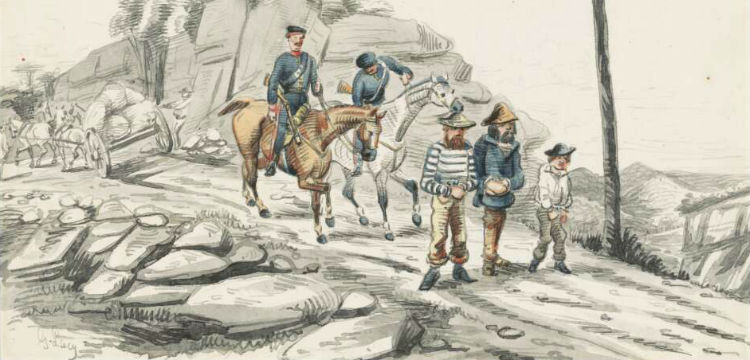
Watercolour prisoners under escort (1850)

National Library Australia

From Victoria...
TROVE
Evening News (Sydney, NSW : 1869 - 1931), Monday 7 May 1877, page 3

A Convict's Fortunes
A romantic case is a subject of inquiry before a Commission held at the suit of the Attorney-General of Victoria and nine claimants, one resident in Ireland and the rest in America. The case is one of interest, and the question of substantially raised is the legitimacy of the claimant. The amount of property involved is estimated at between £60,000 and £90,000. It was realised by one Patrick Cody, who, it is stated, was born in the old goal of Newgate in Dublin on St. Patrick's Day, 1816, and died in Australia on the 16th of June l872. The mother of the deceased was a servant, who was convicted of stealing plate which belonged to her master, Mr. R. Sweetman, who lived in Montjoy-square. She was sentenced by the then Recorder of the city to seven years transportation, and while awaiting the arrival of a convict ship at Cork to take her to New South Wales she gave birth to the deceased, who was baptised Patrick in the Roman Catholic Chapel of St. Michan, which has the entrance directly opposite that leading to Old Newgate in Halston street. At the termination of her sentence his mother got ' the run ' of the country, and married a freed convict named Buckley. Whether this second marriage was bigamous or not does not appear, but the Buckleys prospered. The woman died at an advanced age, and her memory is honoured in poetry and prose in monumental marble in the Roman Catholic Cathedral of Sydney. Her son, having been one of the earliest squatters in Gippsland, amassed a very large fortune and bore a high character for benevolence and rectitude. After her death search was made for a will but none could be found. Whether any existed or not there are no means of ascertaining, as the authorities had all the records relating to the arrival of convicts and other circumstances In their penal life destroyed, lest they should bring disgrace on families which had grown rich and respectable. Two suits were instituted in Australia, one in Chancery and the other in Probate. In the latter a forged will was set up by a man named Maher, but the fraud was detected and Maher sent to gaol to await his trial for the offence. Inquiries were instituted by Mr. Octavins O'Brien J.P. of this city, and the result is that the present set of claimants have come forward. In order to establish these rights evidence has been taken by Commission in the United States, Canada, Newfoundland, Kilkenny, and now finally in Dublin, before the trial which is to determine the question at issue is held in Australia. A number of old records relating to Newgate, also to registrations of marriage and baptism, and of the sailing of the convict ship, were given in evidence, and the examination of witnesses was closed on Wednesday.— Times. February 23.

 re Irish Convict, NSW, Victoria, Dublin Ireland,


From New South Wales...

National Museum of Australia


TROVE...
The World's News, 12 Jan 1938 nla.news-page16091992 convict marriages
Originally published in The Sydney Herald , Jan 11, 1838
Click to enlarge..

Conditional pardon granted to Patrick Geraghty by Lieutenant General Ralph Darling, Governor of New South Wales. Pardon granted by Darling on 11 March 1830; grant confirmed by Darling, after approval by the Secretary of State for the Colonies, on 21 June 1831. Mitchell Library, State Library of New South Wales: http://www.acmssearch.sl.nsw.gov.au/search/itemDetailPaged.cgi?itemID=423843Conditional pardon granted to Patrick Geraghty by Lieutenant General Ralph Darling, Governor of New South Wales. Pardon granted by Darling on 11 March 1830; grant confirmed by Darling, after approval by the Secretary of State for the Colonies, on 21 June 1831. Mitchell Library, State Library of New South Wales:
http://www.acmssearch.sl.nsw.gov.au/search/itemDetailPaged.cgi?itemID=423843


TROVE...
World's News (Sydney, NSW : 1901 - 1955), Wednesday 26 June 1935, page 18 
National Library of Australia
http://nla.gov.au/nla.news-article136321230 

The Convict Barracks...
Click to enlarge..


From Queensland...


Artist's impression of the Convict Barracks Queen Street Brisbane. Neg no. 31216. John Oxley Library


TROVE...
Queensland Times, Ipswich Herald and General Advertiser (Qld. / 1861 - 1908)   Sat 22 Feb 1873 
Story from Victoria...and NSW
 Capture of a Desperate Character
 
CAPTURE OF A DESPERATE CHARACTER
In June last four notorious criminals effected their escape fom the goal at Ballarat. A great deal of daring was exhibited in their mode of breaking out of prison, and every effort was made, but unsuccessfully, to recapture them. The Government offered £200 reward for their apprehension; but even this was not sifficient to induce their companions to give them up. On Monday evening (says the Wagga Wagga Advertiser), however, the police in Wagga received information that one of the escaped prisoners was employed in the establishment of Mr. Walsh, butcher, Newtown. It was stated that he was armed with a knife and a pistol, and Sergeant Carroll, accompanied by another constable, proceeded to arrest him on a charge of stealing a coat. At first the man, who now calls himself Wilson, was inclined to show fight, but subsequently surrendered at discretion, and was marched to the watch-house, where he was charged, under the name of John Darmody, alias Harris, with being an escaped convict. He admitted the charge, and also said that he had on him the marks as described in the Police Gazette, namely warts on one wrist, and an anchor tattoo on the back of the other hand. He was brought before the magistrates on Tuesday, and remanded for a week for further inquiry. There can be no doubt whatever that this man is of the missing prisoners; and it is a matter of congratulation that so desparate a character has again come within the grasp of the gaoler.


From Western Australia...


       Perth Gaol in about 1865 with exterior yards and walls visible  - Public Domain
RUNAWAY CONVICTS
Return of convicts who have escaped from the colony between the 1st June, 1850, and the 31st of March, 1859. http://encore.slwa.wa.gov.au/iii/encore/record/C__Rb2487454__SWestern%20Australia.Comptroller-General%20of%20Convicts.__Orightresult__X3?lang=eng&suite=def

If you go to the link above, you can enlarge far more easily, you will need FlashPlayer.
Lots of detail, including appearance, ship, etc.
e.g. 
15. - From the Perth District, 3rd July, 1854
Reg.No. 2692, John Rose, per Sea Park, tried at Maidstone 10th March 1849;
14 years; painter and paper-hanger; age 35 years; height 5feet 5 3/4 inches; hair light brown; eyes blue; visage long; complexion brown, appearance slight; marks, Woman, Anchor, with word "Hope" inscribed. Figure of a man with glass in his hand, and letters H.H. on right arm. A temple with two women standing at the door; a slop and anchor, and letters H.H. A figure of a man with glass in his hand, with a woman leaning on his arm - on left arm; ring on left forefinger.

Return of convicts who have escaped from the colony between the 1st June, 1850, and the 31st of March, 1859.  http://encore.slwa.wa.gov.au/iii/encore/record/C__Rb2487454__SWestern%20Australia.Comptroller-General%20of%20Convicts.__Orightresult__X3?lang=eng&suite=def


TROVE...
WASun (Kalgoorlie, WA / 1898 - 1919), Sunday 29 June 1902, page 3 
nla.news-article211215237.2 The Convict Days
Click to enlarge...


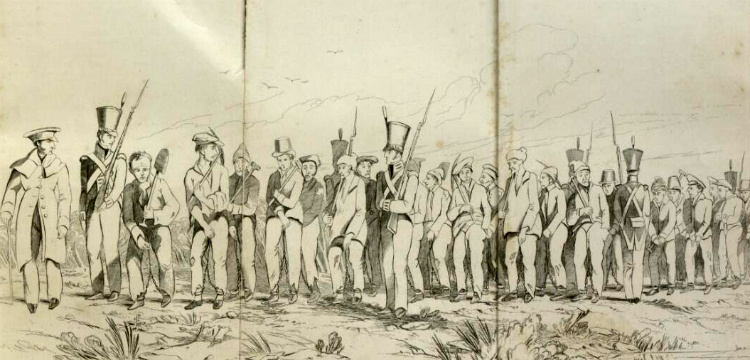
A line of convicts chained together
Backhouse, Edward, A chain gang, convicts going to work near Sidney [i.e. Sydney], New South Wales  1843, nla.obj-138467409