FEELING RESTED?
Time to move on...

Ever wanted to circumnavigate Australia? Well, for the next few weeks, that's what we'll be doing, at least virtually, and clockwise. So as to make sure all states and territories are covered, we started in Western Australia and explored a little of the early history of a small part of this massive state via TROVE...
We're heading inland this week...still in the Northern Territory, heading south east from the beautiful Katherine Gorge to a much drier area...Tennant Creek.
We're heading inland this week...still in the Northern Territory, heading south east from the beautiful Katherine Gorge to a much drier area...Tennant Creek.
Wikipedia describes Tennant Creek as follows...
"Tennant Creek is a town located in the Northern Territory of Australia. It is the seventh largest town in the Northern Territory, and is located on the Stuart Highway, just south of the intersection with the western terminus of the Barkly Highway. At the 2016 census, Tennant Creek had a population of approximately 3,000, of which over 50% (1,536) identified themselves as indigenous.[1]
The town is approximately 1,000 kilometres south of the territory capital, Darwin, and 500 kilometres north of Alice Springs. It is named after a nearby watercourse of the same name, and is the hub of the sprawling Barkly Tableland vast elevated plains of black soil with golden Mitchell grass, that cover more than 240,000 square kilometres. Tennant Creek is also near well-known attractions including the Devils Marbles, Mary Ann Dam, Battery Hill Mining Centre and the Nyinkka Nyunyu Culture Centre..."
"European history of this area began in 1860 when explorer John McDouall Stuart passed this way on his unsuccessful first attempt to cross the continent from South to North. He named a creek to the north of town after John Tennant, a financier of his expedition and a pastoralist from Port Lincoln, South Australia, in gratitude for the financial help Tennant had provided for Stuart's expeditions across Australia.
The Overland Telegraph that once linked Melbourne to London was constructed in the 1870s and forged a corridor through the middle of the continent that the Explorer’s Way and Ghan train now travel. A temporary building for a telegraph repeater station was erected near the watercourse of Tennant Creek in 1872. Two years later, the solid stone buildings of the Tennant Creek Telegraph Station that remain on the site today, were completed by the occupants of the station. This is one of the four remaining original telegraph stations in Australia. Tennant Creek was the site of Australia’s last gold rush during the 1930s and at that time was the third-largest gold producer in Australia. The Tennant Creek Telegraph Station remained an isolated outpost until that time."
 You can read a whole lot more here... Way back in primary school, the little I learnt about Tennant Creek, was that it was known for the gold rush, and for copper..it was a Telegraph Station and that it was a place that was used to water cattle on the long cattle drives, on the times that water was available...
Wandering through TROVE, I found numerous articles supporting all those impressions, but also a whole lot more.
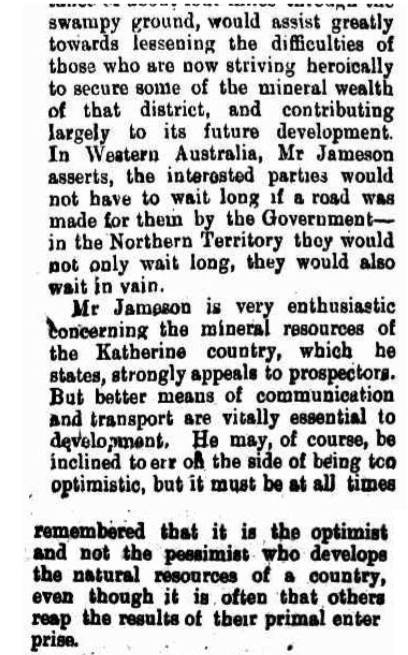
Geelong Advertiser 30 Nov 1883
Tennant Creek Line Man [B 22469] 1895
State Library of South Australia Public Domain, found in TROVE Images

Waterhole, Tennant Creek [B 1436] c 1920
State Library of South Australia Public Domain, found in TROVE Images


Tennant Creek Telegraph Station Reinhard Dietrich Public Domain
State Library of South Australia Public Domain, found in TROVE Images
Adelaide-Darwin Telegraph Line Mart Moppel CC BY-SA 2.0
State Library of South Australia Public Domain, found in TROVE Images

Western Argus (Kalgoorlie, WA : 1916 - 1938), Tuesday 7 May 1929, page 21
National Library of Australia http://nla.gov.au/nla.news-article34484562
Just one of the many aircrashes in the Northern Territory..
Just one of the many aircrashes in the Northern Territory..

The very sad deaths of the pilot Flight Lieutenant and Mr. Hitchcock occurred on a flight in the Kookaburra, see below.
Courtesy of Northern Territory Library
Public Domain, found in TROVE Images

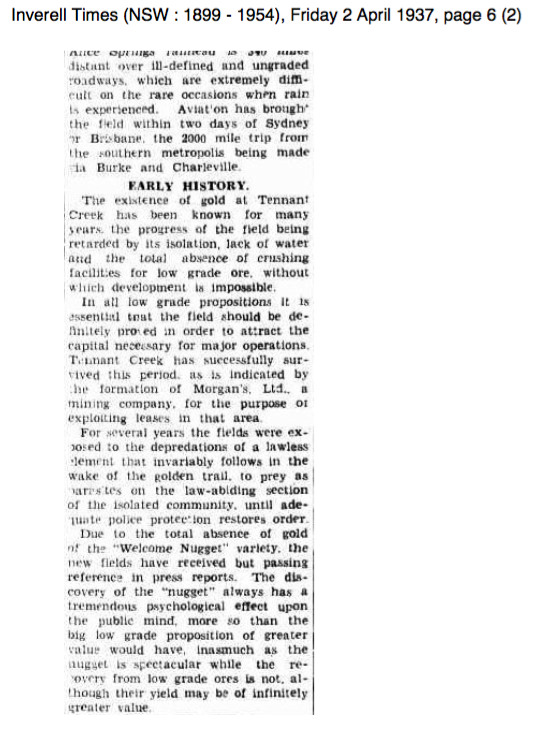
By 1937, gold was in the news again...
as always, please click to enlarge
Inverell Times (NSW : 1899 - 1954), Friday 2 April 1937, page 6 (2)
National Library of Australia http://nla.gov.au/nla.news-article185377732

The reasonably isolated place had it's fair share of tragedies and dramas... as depicted in the West Australian 6 Oct 1934


The Herald (Melbourne) on 9 Feb 1935.
The following article defines the problems felt by many inland and outback areas of Australia. We sure do have some very dry areas, counterbalanced by others with incredible rainfalls, flowing rivers and many waterfalls and rainforests... Australia is a very large island of many contrasts...
Daily Telegraph (Sydney, NSW : 1931 - 1954), Tuesday 15 July 1952, page 8 (3)
National Library of Australia http://nla.gov.au/nla.news-article248644105


I will leave you with some links for further reading and a few more images....


I will leave you with some links for further reading and a few more images....
Miners Memorial Board | Monument Australia x TROVE
Tennant Creek Town Council - Home
The following images are all available through TROVE..


Mmm, where to next ?