Tuesday, 6 September 2016

TROVE TUESDAY 06 SEPTEMBER, 2016... RE JOHN DILLON


JOHN DILLON

John Dillon was my great uncle, brother to my Irish grandmother, Bridget Teresa Dillon.

 I have heard various stories about him, some maybe a little far fetched, but with the help of TROVE, our wonderful digitised media site, I have learnt a bit more. 

I knew he died young from family stories, I knew he worked felling trees, but I knew little else. One of his brothers, my Great Uncle Martin told me two stories about him... one that he had a brush with notoriety....

http://thebackfenceofgenealogy-crissouli.blogspot.com.au/2016/08/tall-but-true.html

and the other was that he had won a lottery and was returning home, after celebrating at the pub, when he was robbed. I had dismissed this story, as none of my family had heard it. I thought perhaps it was just a tall tale... however, I have just found a notice in TROVE which gives at least a little credence to the story...


Dec 14, 1915...
This morning, before Messers Monahan and McNamara, Hugh Colvin was charged with stealing £5 from John Dillon; accused pleaded guilty. Fined £8, and restitution of £5 to complainant, or two months hard labour in Grafton Gaol.

No mention of a lottery win, but I wonder... As I read this item for the first time, I had a very strange feeling, as if I was meant to find that just now. I felt that somehow, I at last had a connection to a Great Uncle I never knew.


From news 'back home', John loved Australia and planned his future here, hoping that more of his eleven siblings would also emigrate. Michael was here originally, followed by Molly (Mary), then John. Later, Bridget, my grandmother, would also settle in Australia, but by then, John had died as a result of an accident.


Mrs. G. McDermott as mentioned was his widowed sister, Molly (Mary), who had been married to Edward Gerard McDermott, known as Gerard, about July 1917. Sadly, Gerard was killed in WW1 in April, 1918, then just five months later, Molly was to lose her oldest brother.

 John is buried in an unmarked grave in the Catholic section of the Coffs Harbour cemetery.

As well as finding the notice of the robbery, I also found this Bereavement Notice.. as with the funeral notice, it has left me with another question to be answered ... who was the aunt, Mrs. M. Casey? Was she a Dillon, or perhaps a McGuane.. at least the Bereavement notice has defined which Pine Creek in NSW she lived, at Bonville, which is near Coffs Harbour.


There is a possibility that she was Mrs. Laura Annie Casey, wife of Michael and sister of John's mother, Ellen/Nellie McGuane... still to verify. If so, that's a whole lot further than I have had on the McGuanes previously... this story remains unfinished.


Though I never knew my Grandmother, Bridget, as she died when my Mother was just eleven, I did know and love her sister, Molly.. Aunt Molly was such a warm and loving person, with a wicked sense of humour. My mother and her sisters told me that she and my grandmother were very much alike.  Though we only knew each other through years of letter writing, I also became very fond of Great Uncle Martin... and his sister, Helen, who married Michael Maloney, as we also wrote to each other. They have all passed now. I did get to meet a daughter of another of the siblings, Susie, when we went to New Zealand. When Cath opened the door to us, not knowing we were even coming, she hugged me before I could introduce myself.. and knew straight away that I was Peggy's daughter.. She had met Mum, Dad and my youngest brother some years before. I am rarely told that I look anything like my mother, so that was a surprise. As for her, she was so much like Mum's sister, Betty, that I was taken aback... even more so when we were invited in, as her house was decorated in the same colours and a similar style...strange how there was such similarity and yet they had never met either. Family ties run deep.


Sunday, 28 August 2016

NATIONAL FAMILY HISTORY MONTH CHALLENGE WK. 3


ROSEMARY AND MEMORIES


Anzac Day, 25th April, was always a day of great significance in my family. 

Three of my father's brothers had gone to World War II and all had returned, for which we were always grateful. My maternal grandfather  had served in WWI, as had many of my ancestors and, as I was to learn  when I began researching, many of my family, some whom I didn't know,  had also fought in various wars. I had a second cousin captured in  Singapore, who was to die there. So it was with great pride, that we wore our sprig of rosemary, pinned to our Sunday best and marched in the annual parade with our heads held high.


photograph by John and Barb Piggott


I grew up in a small country seaside town in NSW, where the war monument took pride of place in the bottom corner of our school grounds, at the main intersection in town. It was suitably fenced off, and we were always taught to respect it. We were too young to understand what war really was, or where ANZAC Cove was...it was just over there... not in Australia. That meant not on the same page as Australia was, in our blue covered school Atlas, so it must have been a long way away. Papua New Guinea however was close by, so we more or less understood that it was at the top of Australia... no Google maps in the '50s. That's where Dad's three brothers had fought.

We went to the morning services only, as the dawn service was only for  the returned soldiers in the main then. We could never understand why they needed to have two services, after all we held a march before we  laid wreaths at the war memorial. It was with sombre faces that the chosen children would lay a wreath. Then it was three steps backwards,  bow your head and wait... for either your parents, or a member of the RSL (Returned Services League), to tap you gently on the shoulder and you would return to your place. I can still hear the haunting sounds of The  Last Post being played on the bugle, accompanied by quiet sobbing from  many gathered around, particularly one of the older women, who had lost  three sons in WWI. She held her head high, but the tears rolled freely  down her cheeks. Hers was always the last wreath to be laid. Each year,  she would place a wreath of hand made red crepe poppies, with three white poppies in the centre, one for each son. Then she would quietly take the sprig of rosemary from her dress and lay it at the base of the  memorial on the side where her son's names were and walk home alone. She  had many friends, but kindly declined their offers of company and spent  this day alone. When she passed away, her grave was honoured with white handmade crepe paper poppies... and a sprig of rosemary. 


Crissouli (c)


 * This is a post I wrote some years ago and have reblogged to fit in with the suggestion of military involvement. I  have given facts and figures in other posts on That Moment In Time. 

Thursday, 18 August 2016

TROVE TUESDAY 16TH AUGUST, 2016


One of my favourite publications to wander through on 

TROVE
is 
The Queensland Figaro

later known as

The Queensland Figaro and Punch

Such a contrast to today's publications, far more 'chatty' and light hearted. I have often found social jottings about my husband's Great Aunts in particular within the pages. Even some of the ads are incredible.

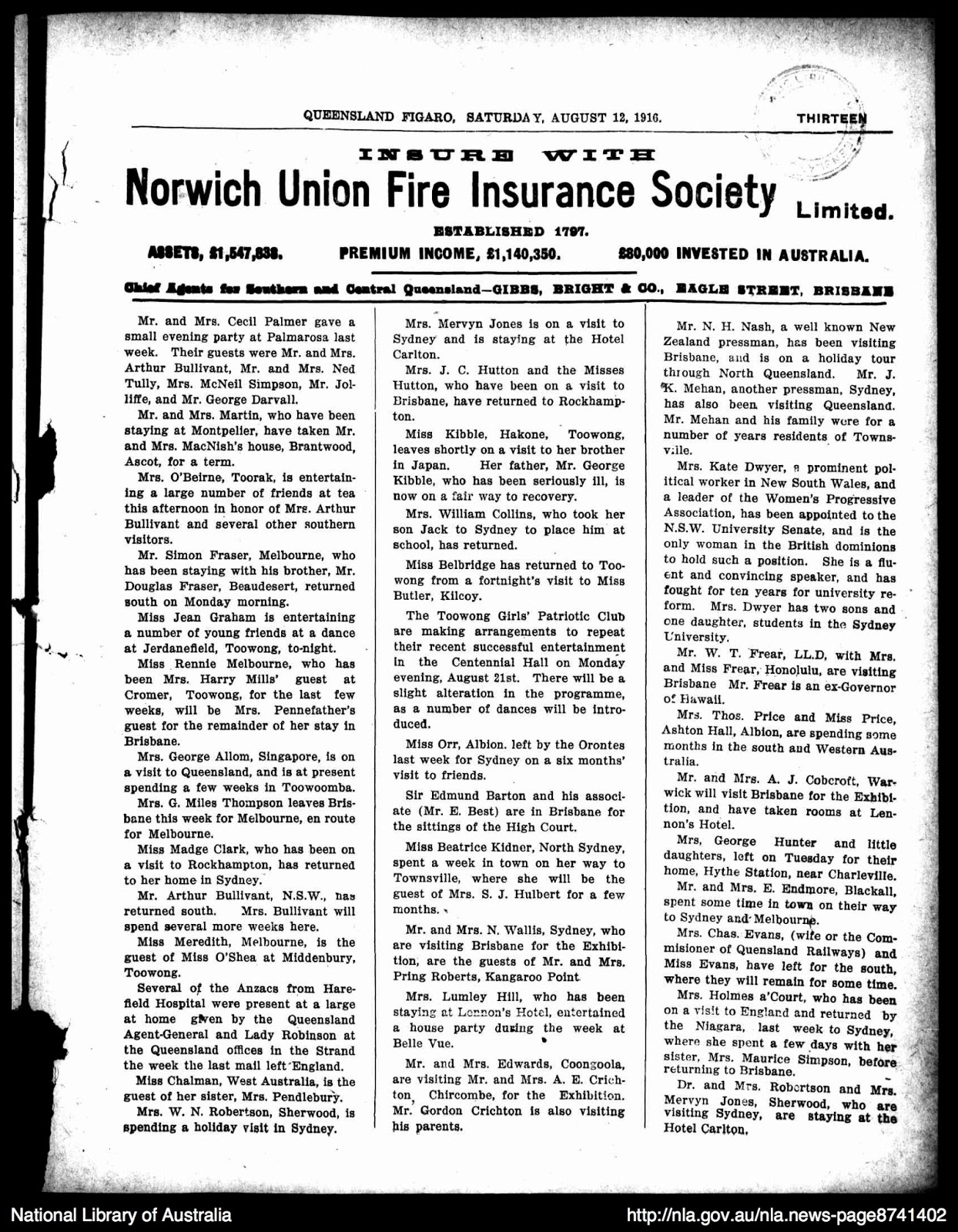
Here is a general selection from an August publication just over 100 years ago. As always, click to enlarge.


Personal notices


Engagements..
Phillips- Mann, Thomas - O'Rourke,  Ewen - Bridgman, 
Counsell - Sealy
Approaching Marriages 
include
Sparkes - Hutton, Ryan - Henderson, Connolly - Grant,


'Do Without Week'


The Strand in Brisbane was showing 
'The Heart of the Blue Ridge"..
cnr of Albert and Queen Street? Closed before 1920...

Comings and goings...  some of the names Bullivant, O'Beirne, 
Graham, Fraser, Dwyer, Cobcroft, Price...
Holmes a'Court..

                                                                 Rockhampton News


New Queenslanders (births)
Obituaries
His Majesty's Theatre
The Tivoli
and the highlight..
Finney's Underwear Sale


Everything old is new again...


Sunday, 14 August 2016

NATIONAL FAMILY HISTORY MONTH CHALLENGE WK.2


 BY THE SEAT OF HIS PANTS...

He often called it his 'very own shop'... 'You could find all you needed there...'

'There' was the local dump, conveniently situated down near the road, in the property beside the house and the farm. It provided him with wood offcuts and some large pram wheels - not for a billy cart, but for a hand cart, perfect for carting the fire wood into town. He hawked it from place to place, being paid just a few shillings for the whole cartload. Often he had to make 2-3 trips.

The wood came from the dump and trees cleared on the farm. This 10 year old would work on the farm, as did his siblings, before and after school and on the weekend.

The money went into the family jar, as did most of anything the rest of the family earned. He was the youngest of nine.. Harry was 23, working on the farm.. Mary, 21, working as a housekeeper in the local hotel, Con, 20, also worked in the hotel, Nita, 19, worked at home, George, 17, on the farm, as did Dave, 16, and Peter, 14... while Sim, 11, was at school, with Vince, 10.


Catsoulis family and friends 
(c) Catsoulis family


None of the family went on to high school, not unusual for that time. By the time Vince finished primary, he was still too young to finally leave school at 12. With no money to go to the nearest high school, despite passing a bursary exam, Vince stayed at the primary for most of the day, working with the headmaster, Colonel Lamb. He helped in class preparation, running messages and helping at the headmaster's house. In between, he continued to learn all he could from Colonel Lamb's extensive library. With his love of anything mechanical, he was soon fixing some of the few cars in the small town... and the water pump for the well at the school house, which failed often.

He learnt to drive on the farm, first on the very old and much repaired tractor and then on a small truck. By 13, he'd left school and worked alongside his older brothers and father on the farm.

The hours were long and the work hard. The family had struggled through the depression, but managed better than many others, as they grew most of their own food. No one was turned away hungry. The railway line was very close to the home and many a man down on his luck would walk along the tracks and try their chance at the house.

Photo taken from the railway line looking down towards the house. 
(c) Catsoulis family


 Rather than just be given a meal, they would keep their pride by chopping wood in exchange, or if too unwell for that, they may have been asked to help my grandmother to pick fruit from the highest branches of the trees. She was small in stature, but big of heart. If shelter was needed, there were several sheds, complete with bedding and some clean, though well patched shirts and pants if needed. 

Few took advantage - I was told a couple took some bedding, but my grandparents' attitude was that their need was greater. There was one Dad talked about who returned to the farm some years later with his family to 'meet the lady who saved his life'. He also brought an eiderdown and some shirts, to replace those he'd 'borrowed' so long ago. He kept in touch with the family for some time after.

During what we would now call his 'teenage' years, Vince was driving the truck into the rail, laden with boxes of vegetables to send to the Sydney markets. Mostly, he'd unload it by himself, then either return to the farm for more, or do the same with produce from other farmers who had no transport. This carrying was to be his first 'real' paid job as he called it.

 As well as the farm around the house, the family took up lease of land south of the town, near Hungry Head. They grew small crops, tomatoes, carrots, watermelons, lettuce - whatever was in season and suited to the conditions. My grandfather kept great records, noting when each crop was planted, the conditions, what was used for fertiliser, progress, etc. He was meticulous with his notes. The labels for the market boxes were now labelled Catsoulis and Sons. 

Jim Kolangtis on horse, Harry Catsoulis walking behind with plough.
(c) Kath Capsanis


They were well known for the quality of their produce at the Sydney Markets. It seemed that the years after the depression were finally turning their lives around for the better. My Aunt told me that the best thing to happen to show that things were better, was that she was able to have store bought underwear, no more bloomers made of flour sacks. 

 Not that that was unusual... flour sacks were used not only for underwear, but shirts and dresses, for bedding and household linen. Women became very inventive and flour mills even used some printed fabrics, to make it less obvious - as if no one knew the patterns. Dad told the story of ripping the seat out of his pants...that worried him little, as he knew they could be mended yet again, but he had to get home with his flour sack underwear showing, thankfully, no labels that day.


World War II hit heavily - three of the brothers joined the forces. That left just my father and three brothers to run the farm, under the guidance of my now ailing grandfather who had started to show signs of heart trouble. By now, the family had been awarded contracts to supply the army with as much food as they could grow, but there was a minimum amount that had to be supplied or they would lose their contracts. The specifications were very particular... the produce had to be of a certain size, shape, weight, quality and and always packed exactly the same. It seems if the army could have had the produce salute, it would have.

 Dad often talked of looking very thoroughly for any odd sized vegetables as that they would go into their own cooking pot. 

 Dad was just 16 when the war began.. he  and his brothers at home, were listed as being in an essential industry - yet he was still the recipient of a horrid white feather. I was so pleased in recent years to be able to organise a long overdue Certificate of Recognition for his service to the country during WWII. Sadly, it arrived just a few days after his funeral.. but somehow, I feel my 91 year old Dad would have known and smiled, ever so shyly and humbly.


This week's challenge is 'to honour your working ancestors and the challenges they faced'.

I've chosen to write this in segments. I hope you enjoyed Part One...


Reading re the Great Depression...

* http://www.australia.gov.au/about-australia/australian-story/great-depression
* http://sydneylivingmuseums.com.au/stories/skint-making-do-great-depression